
- 01How a broken elbow at age 9 redirected Simon from sports to classical piano — and eventually to electronic music (01:47)
- 02The story behind Simon's student band Headless Chickens with Thom Yorke at Exeter University (10:43)
- 03How acid house in 1987 opened the portal from rock and industrial music to electronic production (16:05)
- 04Why Simon's first DJ gig was a 5-hour set to 1,200 students — having never mixed before (21:31)
- 05The rise and fall of Lunatic Calm — from a Fatboy Slim remix to label betrayal over a Prodigy-mocking ad (25:34)
- 06How Castle Morton and the Criminal Justice Act turned UK rave into an act of political rebellion (39:20)
- 07Touring the US with Crystal Method and playing the first Coachella (32:17)
- 08Why four album releases were destroyed by distributor collapses — and how U and I Recordings was built in response (57:35)
- 09The cortisol science of DJing: why a 2-hour set produces parachute-level stress hormones for 24 hours (1:00:33)
- 10The Shadowmaker: six years of therapy through music, and why the art must come before the marketing (1:24:53)
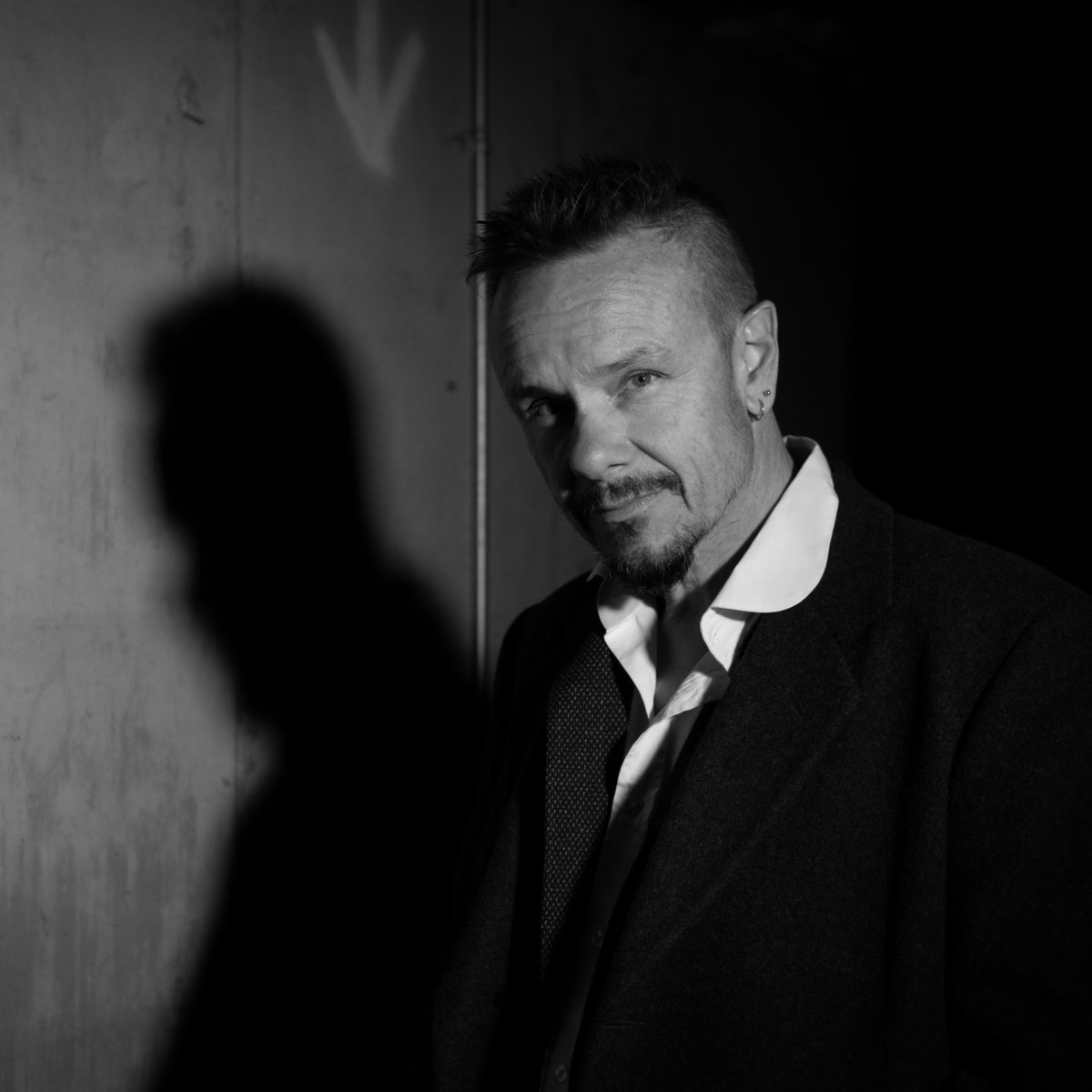
Simon Shackleton is a UK-born electronic music producer, DJ, singer, and visual artist whose career spans nearly four decades. As one half of Lunatic Calm, he released on Universal/MCA and licensed music to The Matrix. Under the Elite Force alias, he became one of breakbeat's most respected producers — winning Beatport's Breaks Track of the Year in 2011 and touring internationally from China to Coachella. He founded Fused and Bruised Records (1996) and U and I Recordings (2006), releasing over 80 singles across multiple aliases including Frac-R, Futurecore, and Zodiac Cartel.
His latest project, The Shadowmaker, is a deeply personal song-based album drawing from Massive Attack, Portishead, and Nine Inch Nails. Simon is also a landscape photographer and writer. He currently lives in the United States.
Origins: Jazz, Classical Piano & Cathedral Choir
All right, welcome to episode seven of A DJ's Journey. I am very pleased to have one Simon Shackleton and a few other names be with me this week.
Thanks for having me on, man. I'm excited to chat. I think it's going to be an interesting one.
Yeah, I think so. We've got a lot of ground to cover. We'll certainly hit on some of those, your various names and personas, both personal and with different names. We'll hit on that later, but I'll start off where I start off with everybody. What was music like for you growing up in your household?
My dad was very much into jazz. So my earliest kind of memories of music were dancing to super fast live Louis Armstrong recordings from when I was about three or four. My parents, they're not around anymore, but they used to tell this story of when I was two years old and we were on this long journey with them and they were playing some music in the car and then singing along to this piece of music. Apparently I demanded that they stop the music and then I sang it back to them in tune. So they kind of knew that I had some kind of a musical thing going on at that point. So I think they, to their credit, they just exposed me to as much music as they were able to at an early age.
I started piano lessons when I was five. But at the time I was much more interested in sport. Big soccer fan and I didn't really pay attention to the piano stuff. I kind of just went because I was told to go. And then I guess when I was just, I just turned nine, I broke my elbow really badly in five places and actually nearly had to have it amputated. So it kind of really stopped the love of sport or at least playing it in its tracks. And then I really kind of fell into music at that point.
I was learning classical music. We have in the UK a system of classical music grades that you can take from one to eight. I think I did my grade one, maybe when I was nine, just after I broke my elbow. By the time I was 14, I'd done all of the grades and was certainly not concert pianist level, but I was fairly handy on the piano and I used to spend a lot of time in my spare time just improvising and just playing around and writing music.
I formed my first band when I was 14 with Howie Saunders, who I went on to do Flickanoys with and then we were the two halves of Lunatic Calm. So he was one of my oldest friends and our band at school was a rock band and we just did various kind of heavy metal covers really. We went to the school headmaster and just told him that we want to do a gig in the school hall. And we sold tickets and I think we had three or 400 people show up.
When I was nine or 10, I went to King's School in Rochester. I was quite a prodigious music student. Aside from the piano, I was in the school choir. And then within a couple of years, I became the principal treble or soprano soloist in the choir. It was a cathedral school and we used to do huge carol services each year at Christmas where you'd have a thousand people there. And I'd walk out front at the beginning of that and just sing solo to a thousand people from sort of 10 or 11 years old. Honestly, it didn't really faze me. I've always been quite introverted, and performing meant that I could just bury myself in the performance and the music side without having to deal with the people stuff.
From Rock to Rave: Motorhead, Acid House & the Portal to Electronic Music
I went to Exeter University and as it turned out, Exeter University was a real hotbed at the time for music people. I got to know Tom — he was in the year below me, he was a year younger than me and he was at the art school and I was studying music, but the kind of music that you had to study there was classical.
When I first left school, I went to Birmingham University for a year and completely messed up my year and got booted out. I was quite a rebel. I didn't want to go to university. My parents were absolutely adamant. Birmingham was not my first choice — I was only accepted there about a week before I was due to go. I ended up staying with this 80-year-old lady's house right on the other side of the city. I never got to meet anybody. And then I also bizarrely got cast as Judas in Jesus Christ Superstar.
I reapplied, got into Exeter. And I met Tom quite early on, shortly after he joined and we formed a band called Headless Chickens. We almost became like the go-to student band. Whenever another band was coming through, we supported a whole bunch of people like De La Soul, Fugazi. It was a really interesting eclectic mix. I played with Tom for a couple of years and then I wanted to take things a bit more seriously, so I formed a band called Flickr Noise and bizarrely he chose to go off to Oxford and do some Radiohead thing. God knows what happened to them.
First band I ever went to see live was Motorhead. I kind of went in at the deep end of it. That was 14. My parents said, if you can afford the ticket, then you can travel up to London and go to the gig. And I think Ace of Spades was actually the first bit of vinyl that I ever bought.
In 86, 87, I started getting into a much broader range of music. 87, I actually discovered Acid House and that was the portal into electronic music. I was starting to listen to quite a lot of industrial music — bands like the Young Gods, this Swiss three piece who sounded like a very heavy industrial guitar band but had no guitars at all. They literally sampled everything and then played it back live on keyboards. And Sonic Youth and that whole New York no wave scene.
Lunatic Calm: The Rise, the Betrayal & Crystal Method
What got me into DJing in the first place was Tom, funnily enough. He became the DJ at the biggest student night at the university — Saturday nights, venue capacity was about 1,200 people. I used to work security there. And when he left, I basically went to the entertainment people and said, I can do that. That was my first experience of DJing — 1,200 people doing a five hour set and having never tried to mix anything before.
When I left Exeter and moved up to London, that's when we really formed Flickr Noise and started taking that a bit more seriously. Mine and Howie's goal was nothing more complicated than we want to make a living out of making music. We got signed to MCA publishing on a development deal. They gave us 10,000 pounds and said, go and buy a studio. Learn how to use it and make some music.
We got signed to Universal records. We decided to change because the Flickanoys stuff was starting to morph into something different and we really wanted to create a new name and start again. Universal said, we want you to make an album, so go away and make an album and here's a bit more money to get a better studio.
They really wanted our song Leave You Far Behind to enter the top 40 in the UK. When it didn't, they basically tied our hands and said, we've got this advert that really took the piss out of The Prodigy. We said, that'd be absolute suicide. They forced us to do it — said they'd pull the album if we didn't. And sure enough that week, all the music magazines gave us absolute shit. The A&R guy got fired. They never picked up the phone after that. They made us sit in the contract terms for about three or four years.
We came out to the US and toured with the Crystal Method. Electronic music felt like it was in its absolute earliest sort of incarnation in the States. Crystal Method were really the poster boys for electronic music. We did six weeks around the US and played every major city and played to sold out crowds. We got a lot of traction from that, but because we didn't have record company support to do much with it, we were just stuck in that contract hell.
Castle Morton, Criminal Justice & the UK Rave Revolution
At the end of 96, I'd started up Fused and Bruised in the UK, my first record label. That's when I first started releasing solo stuff as Elite Force, Frac-R, Futurecore, all of these different names. Because I just had more music than I knew what to do with. We started doing monthly label nights — we had a residency at this place called Dogstar in Brixton, which was quite legendary. It was basically a pub that at about nine or 10 o'clock turned into a club.
Acid house became rebel music. Those parties escalated so rapidly and almost uncontrollably in the UK. It all culminated at this event at an old disused airfield called Castle Morton. Spiral Tribe were there and within three days there were 40,000 people. Ten days later the party was still going and people were still arriving. The government brought in the Criminal Justice Act — the act of going to these acid house parties was a political act. You would encounter the police, they'd try and stop you, you'd try and get around the police and sometimes there'd be fighting. You were literally fighting for your right to party.
The pivotal moment was the advent of MDMA and the easy access to ecstasy. All these football hooligans were actually going to the games and popping a pill and hugging each other on the terraces and singing all these Manchester-style anthems — Stone Roses, Happy Mondays. The Criminal Justice Bill made it illegal to have gatherings of more than 12 people playing repetitive beats. If people were found hosting a party, they could confiscate all of the equipment, all of the records, everything. Spiral Tribe's sound systems literally left the country.
Elite Force, Label Wars & the Burning Man Years
We eventually signed a deal with City of Angels in the US and they did a deal with Virgin to pump some money into it. And then City of Angels basically folded the week that our second Lunatic Calm album was due to come out. Virgin put out the minimum number of copies they needed to not be in contractual breach. We were just done. So whilst we're in that holding pattern, Elite Force had started taking over. I played at the first Coachella. I think that was 99.
We're both repping our Burning Man camps here — Space Cowboys, District. So what was your first year you went to Burning Man?
That would have been 2009. That was actually Rock Bottom. Which to me seemed like the best thing in the world because it was just a couple of hundred people in a pokey little tent.
I was at Roots Society and Crystal Method were playing. This guy came up to me and goes, mate, I absolutely love your music. I've never run into you before. I'm like, you look really familiar. And he said, yeah — it's Phil from Orbital. He said, I never play out here, but I've come out most years if I can. It's like a busman's holiday — people just come out anonymously and just be one of the people enjoying the ridiculousness of it all.
U and I started in 2006 as a response to multiple other labels I'd been signed to going bust. Both of my Elite Force albums — No Turning Back in 2003 and Modern Primitive in 2006 — my distributors both went bust in the week that my albums were being released. The warehouses got massive padlocks put on them and you couldn't get the music out. Between 2006 and 2014, I released 80 singles and a whole bunch of albums on U and I. Elite Force was absolutely firing — I was routinely playing all over the world. Flying to mainland China for the night, flying to Seoul for 24 hours.
DJing, Mental Health & the Cortisol Question
Such a mental lifestyle. I remember talking to BT about it one time and he's completely sober, I believe. He'd talk about the same thing — gig's over, what are you doing after? Gonna go back to hotel and make some music, fly home tomorrow, wife and kid, maybe go surfing, and back to the music again.
I saw some scientific research a few years ago. Someone had done research on the cortisol levels from performing, specifically from DJing. They found that even two or three hours after a DJ set, you still have a similar level of cortisol in the body as if you're parachuting from a plane — and it takes 24 hours for that cortisol to return back to normal. And then you're in another club doing it all again. And then suddenly it's Monday and you're back at home with your family.
For my own journey — I was not sober, played the same song twice. It took some of those comments and playing the same song twice to where I just said, you know what, I actually take this seriously and music means too much to me. I don't want to do that anymore. I want to put my best foot forward.
Spain — they are incredibly militant over there. There's no latitude for you to drop a four-four even accidentally. I saw MK do that once. He did an entire breakbeat set and then his last track was this sort of banging acid track. The entire front row — about 3,000 people — just stood there with their thumbs down. Everybody stopped moving.
One of the things I always found really interesting about Burning Man — unlike any other gig where you'd have people in the audience with their phones out, at Burning Man it's usually the DJ that's got their phone out. They're watching the crowd. You had a crowd of people who literally weren't thinking about anything else other than being in that moment together.
There was a perfect storm around 2012 where social media became ubiquitous as did smartphones. The big change was the like button. It was almost the beginning of constant doom scrolling. As a result of the last 13 or 14 years of social media, we now live in such a visual world. I'm now going to make music for the platform. I'm going to make music for TikTok. People sending you a two minute 50 second "extended mix" — and then the radio edit was a minute 30.
The Shadowmaker: Art Before Marketing
I've always been interested in photography. It's almost like slow photography — I like being in the space, enjoying it, then trying to capture the essence of the moment. My friends and I came up with the idea that it's maybe less about photography and more about meditography. A cross between meditation and photography. Sometimes I go and stand in a field for four hours overnight and just wait for the sun to come up and shoot the Milky Way.
The Shadowmaker has been a very visual project. A very honest project creatively. I don't have anybody else involved at all in the creative process. I master my own stuff. I mix down my own stuff. I sing it, I make it, I program it. A mix down typically takes six or seven hours — it's a day's work. But I love that part of the process. When I started writing that music about six years ago, it really was therapy. A means of working through emotions through music. These songs are much more personal — more closely aligned to Massive Attack, Portishead, Nine Inch Nails. It's far and away the most personal collection of music I've put out.
Over the last few years, there's been a really great alignment between understanding the tech I'm using extremely well — I use Ableton to produce and master everything, I understand it like the back of my hand. There's no impediment between what I've got in my head and what's going to end up on the track. The king was the song. How do we want to show the song to people? Some of those tracks have 120 parts but they sound very minimal. It was a subtractive process — is that adding anything to the party or is it just me indulging myself in production tomfoolery?
Off the back of that album, I came back wanting to remix a couple of the tracks. I've actually got an entire album now with remixes. The Addicted to Lies remix is 10 and a half minutes long, because that's what it felt like it wanted to be. It almost feels like in the quantum realm where you could have a thousand versions of the same musical idea coexisting simultaneously. If I give the track to Lee Coombs to remix, he'll show another version of the same musical DNA.
I've started work on another album of Simon Shackleton material. A couple of years ago I wrote this entire body of work called Dream States — 14 or 15 tracks, very emotive electronica. What I'm doing for this new collection is I'm basically reverse-remixing them into songs. So effectively the remix album's already written, but the original songs haven't been created.
Being fearless and honest with your creative direction and ideas is just fundamental. There's a tendency to get confused between marketing and creating. A lot of the time people go into the studio with the marketing already sitting there — I need a Beatport number one, I need this to be played by 30 DJs in Spain. Before you know it, your creativity is just crushed. Figure out the art and then figure out the marketing once you've made the art. It's really that simple.
Good words for all artists and DJs. Simon, thank you so much. You've been very generous with your time. Always a pleasure talking with you and glad to have you on the podcast.
You too, man. It's been an absolute pleasure. Thank you.