
- 01How growing up with a record review columnist father gave Myagi access to every major release before anyone else (02:26)
- 02The night Myagi and a friend infiltrated Fatboy Slim's entourage at a Toronto radio station — and accidentally blew off DJ Touché from the Wiseguys (~25:00)
- 03How tracker software and hexadecimal editing on the family computer launched a production career (~15:00)
- 04Why Myagi targeted UK labels from Canada and how his debut single hit number one in the national record pool (~30:00)
- 05The 2004–2008 touring peak — seven months a year, Vancouver to Shanghai to Australia — and why he's been on "bonus laps" ever since (~45:00)
- 06The Brazil disaster: visa miscommunication, Montreal snowstorm, overnight bus, and a breakdown at JFK (~55:00)
- 07Playing Mighty in San Francisco for the first time, Paris on a converted icebreaker, and Vienna inside an art museum (~1:00:00)
- 08The album vs. singles philosophy: "Writing a single is planing one piece of wood. Writing an album is building furniture." (~1:10:00)
- 09Why "would teenage me have loved this?" is the only metric for whether a production is finished (~1:20:00)
- 10The Space Cowboys and Burning Man community connection with Deckard (~1:30:00)
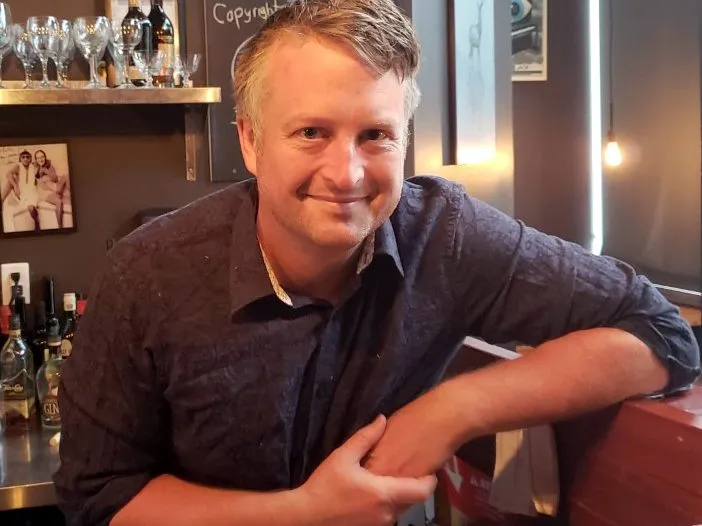
Andrew "Myagi" Mavor is a Canadian-born producer and DJ from Peterborough, Ontario, now based in the Berkeley Hills. His unusual musical education came from a father who ran the longest-running independent record review column in Canadian print — meaning every major label release showed up at the front door. Production began in his teens with tracker software and hexadecimal editing; the DJ impulse was triggered by seeing Fatboy Slim play the Warehouse in Toronto in 1999.
Myagi built his reputation by targeting UK labels from Canada, with debut single Wishy Well reaching number one in the Canadian Stick Man national record pool. His album Three Years of Sunrise, released on Freddie Fresh's label in 2008, was written mostly during a single month-long creative burst. At his touring peak (2004–2008), he spent seven to eight months a year on the road globally. He has remixed Crystal Method and Phil Hartnoll (Orbital), and is a longtime Space Cowboys and Burning Man community regular.
Origins: The Record Review Column & An Eclectic Education
All right, I am pleased to be joined today on A DJ's Journey by one Mr. Myagi. How are you doing, sir?
Doing very well, Friday afternoon, slightly overcast, but it's gonna be a solid weekend of really exciting gardening and music. So yeah, I'm good.
Coming from the Berkeley Hills, we're in a nice sunny day. Awesome to see you again. We were just chatting very briefly before hopping on here. And yeah, I think we were saying it's back till like 2012 since we last hung. And a few years there where we definitely spent some good times together, whether it was Breakfast of Champions or Burning Man. So looking forward to going back to your origin and the in-between and what you're up to now. So I'll hit you up. What was music like for you growing up?
Eclectic, which probably explains a lot, I think. My dad actually had a record review column in the paper in the town I grew up in. And it was, I think it was the longest running independent daily paper that had like a custom record column. It wasn't controlled by any labels or anything. So when I was a kid, basically like every major release on every major label, a lot of indie labels would show up at the door upon release. So I'd come home every day and there'd be a box out front of the house with sometimes like 10 albums, sometimes like 30 and like everything, man, like everything. I remember getting the Nine Inch Nails Down In It single when I was like, I would have been like nine or something, nine or 10.
So when those records were coming in, dad gets to them first or were you taking a look through them and listening as well?
Yeah, sort of. I mean, like there was a lot of stuff where he would go through and we would fight over albums for sure. There's stuff where he would kind of lay dibs on it. I was super ADD as a kid and I'd mismatch vinyl sleeves and CDs with cases. He'd be like, you know, where's this? I'd be like, I don't know. I didn't even know I had that. But normally he would get first crack at it and then there was like entire genres where eventually he just ceded territory to me and it was like, yeah, if it looks like it's got synths, that's all you.
So synths. So you, well, and maybe similar to myself. Like for me, I pretty much loved all kinds of different music I was hearing on the radio or eight tracks. So what were you gravitating towards and at what age?
I think probably I would have been maybe like 11 or 12 where I started really getting some sort of semblance of taste in music. And a lot of it was very typical. I think we're similar ages. So I think we kind of grew up around the Columbia House era. There was a lot of pepper mixed in with the salt, right? Like I'd get these samplers from Warner or something like that. And it would be like some tune by a band called National Velvet. So I'd be listening to like Guns N' Roses and all the typical stuff. And then it would be like that. And then like, you know, some Joy Division in there. It was eclectic for sure. A wide net was cast.
From Tracker Software to Turntables
And you started getting into writing music not long after that, right? Like mid teens.
I grew up in like a pretty crazy time in the town that I live in now. So it's a town of like 30,000 people. Not big. And there isn't really a giant amount in the area. It's about two hours from Toronto. It was the mid 90s and grunge was big and there was this kind DIY punk ethos. And as a result, growing up in this small town, pretty much everybody that I knew was in a band. You'd be like, everybody was in a super group of some sort. And growing up it would be like three, four nights a week. There'd be probably like 150 kids downtown at this place called the 10 Day Cafe watching their friends play shows. For that to exist in a town of 30,000 people is certainly really, really weird.
For sure it was Nine Inch Nails. Like there was no way around it. Pretty Hate Machine — I knew a couple songs by Nine Inch Nails and then Downward Spiral came out. 100% game changer. Especially because I immediately picked up Broken and Pretty Hate Machine and then started looking at the Woodstock 94, 95 footage and the Lollapalooza footage of Nails playing live. And I was like, OK, I don't want to do this punk thing anymore. Like this is what I like. Whatever this is, this stuff that sounds like the goddamn apocalypse.
It's awful. Like it's super bad, right? My idea of how to do this is like rent an Alesis HR-16 from the music store and get a Tascam four track and fire it through a distortion pedal and then scream through a mic. But rapidly, my arc of development started mirroring what was available technology-wise. Computers started showing up in houses. Family computer was something kids had access to. And so I immediately downloaded tracker software and started learning hexadecimal stuff and editing waveforms. And then the internet was a new thing. So you're trolling through all the websites you can find to find samples. And you're programming them into Fast Tracker 2 and CoolEdit Pro and all that early Windows stuff.
It's so obtuse. So backwards. Your flow is vertical, not linear. And it's like if you want stuff in a certain spot, you're programming it in based on just hex codes. And sometimes it's just a trigger. Sometimes it's like a multiple of a trigger plus velocity. It's not like you walk away from it feeling like you had a gratifying music making experience. It's really good for extremely ridiculously glitchy things. That's kind of why Breakcore really came out of that tracker scene, because that software just naturally leads you towards doing insane, crazy chops and super fast repeats.
Fatboy Slim, the Warehouse & the Moment Everything Changed
DJing came later. The impetus was never really to DJ. It wasn't until I saw Fatboy Slim play. Yeah, it was 99. And that would have been at the Warehouse in Toronto. He was touring with Touché. I just wanted to write music and I started immediately firing it out to CBC, which is our national broadcasting corporation. And I started picking up plays on CBC back when I was like 17, 18 on a show called Brave New Waves. That stuff was actually very primitive musically, but pretty esoteric.
Probably, it would have been when I was in first year university and I had seen Fatboy Slim play at that point. So I had a much more defined idea of what I wanted to make. And it was Big Beat. You know, obviously it morphed into breaks from there. But at the start, it was very sample heavy, very funk meets hip hop meets 125 to 135 BPM. Sample breaks, lots of horns, acid synths, like all the good stuff.
OK, so that was 1999. And I was in Toronto for that show with my friend Dale. So Dale and I were walking up Yonge Street and we'd been having a pretty solid afternoon so far. And we were passing by this radio station. So we're walking up Yonge Street and we passed by, I think it was the Edge, which was a radio station at the time. And there's this limo that kind of pulls up out front as we're passing by. And I just — it's the whole fake it till you make it thing, right? So I turned to Dale and like, this is, you know, Norman Cook's at the height of his career at this point. You've Come a Long Way, Baby has been out for about a year. He's just on this nonstop global tour.
So Dale and I just fall in line and get in with the entourage and slip in between a bunch of bouncers and security and get dragged right into the radio station. Brought right down about five feet from the mics and realized, OK, yeah, this is Norman Cook and he's here for an interview. We landed ourselves directly next to the guy. But standing next to me is this guy who just tries to strike up a conversation. Dale and I both just sort of blew him off a little bit. And then later on that night, we're at the Warehouse. I realized that guy was Touché from the Wiseguys. Like he was legitimately actually trying to have a chat with us. And he came out and just absolutely killed it. I still remember the guy playing the Superman theme song. Seven or 8,000 people just going completely insane.
Building a Career: UK Labels, First Releases & the Touring Peak
The first record that I had come out, I was writing lots of stuff, but I put out a record called Wishy Well on a label called Two Orsion Revolution, which is out of Canada. And there's this national record pool called Stick Man, which was fairly big at the time. And it was released to them and it got number one in that record pool, which was a big deal for me at the time because it was a nationally released pool of honestly just taste makers who were gigging club DJs.
I wasn't shooting small. I was doing everything I needed to do in school to a moderate degree. But I wasn't into it, I didn't do well at it. Part of that is the fact that at the time, I was actually really quite focused on music. So the intent was to get music to show me around the world. And I loved travel. I had the intention of using music as a vehicle to get me out of small town Ontario. I immediately just started focusing on getting signed to UK labels, getting gigs overseas, getting airplay overseas. I didn't want to be part of the community necessarily. I just wanted to do what I want to do, which was get out there.
I also sent stuff to Freddie Fresh. Freddie is, besides being ridiculously prolific, he was oddly accessible. I remember getting a seven inch and just emailing him and being like, hey dude, I have a piece of music. Do you want to hear it? And he was like, yep. It was a song called I Got Beat Up by 303. It used Rebirth running on one PC tower, the whole thing clocked off an MPC 2000 XL. I played the bass parts using a Fender P Bass and the guitar parts using an acoustic electric. Freddie picked it up and put it out on Howlin as a seven inch. And the next thing I knew it was on the BBC One track listing for John Peel's radio show. He opened up his show a bunch of times with it.
That was kind of the crazy times. I would say 2004 through 2008 was like that was the day for me. I played San Francisco for the first time and then it just didn't stop. I would say I traveled for about seven or eight months of the year every single year. That goal of what I wanted to do with music of having it show me around the world — I attained that in those years to the point where I've always felt like I was kind of on bonus laps since then. There was one weekend where two remixes had come out, the Plumps album had come out that had licensed a track of mine — Finger Lickin was, they ruled the roost at that point.
I flew from Vancouver to Shanghai and I was in China for like three days and then I was back to BC and then I was off to Australia and then I was back from that and then I was off to Halifax and it was like, what happened? Like this is amazing. I think I knew how special it was when it was happening. I was always very genuinely happy about the fact that I was doing it.
The Road: Brazil, Paris, Vienna & Playing Mighty
There's a lot of memorable ones. I think Mighty the first time I played Mighty — Murph and Seismic brought me down — that was pretty magic. Because it was like walking around Haight-Ashbury, which obviously, I know it's touristy, but when I was a kid, it was like, this was the epicenter of the counterculture that I was always interested in. And so just being there was like this magic thing.
Paris, when I played Paris, that was incredible because I played at a club called Bâtofar, which is a converted ice breaking vessel that's actually on the river Seine and the acoustics in that room, because it's actually a boat and it's underwater for the most part, were just amazing. The entire experience of being in Paris and staying at this guy's apartment downtown in the city, hanging out for a week and then going out to the countryside. Utterly incredible kind of travel story.
And then probably the other big one — playing in Vienna. I played a club in a museum quarter where it was actually part of the art museum. Café Leopold is the name of it. There's a Monet exhibit on the same floor as the room I'm playing in. You just kind of look at where you are and what you're doing and you go, wow, this is so neat to get the opportunity to do anything like this ever.
My most memorable travel story, which is massive and truly negative, was Brazil. I was booked to play in São Paulo. These guys who booked me, we talked about visas and they were like, it takes you five days to get a visa. And I was like, no, I'm coming from Canada. It's five days if you're coming from the UK, but I need two weeks. They rebooked me. The flight was going to leave Friday evening from Montreal, transfer at JFK, fly overnight. Montreal gets hit with this epic snowstorm, shuts the city down 100%. No planes are landing.
So I hop on a bus and take a bus from Montreal to New York. It's a spring break travel weekend. Awful. We get held up at the border. I arrive at the Port Authority like five in the morning, take a cab to the airport. It's 40 minutes before the plane leaves. I come up to the gate and they're taking the TAM Brazilian sign down. They're like, where's your ticket? Where's your paper ticket? And I'm like, they definitely didn't print me a paper ticket. And they're like, OK, so you're not going to get on this plane. At this point it had been an overnight bus, 10 hours, to get to this airport. And I nearly had a breakdown at the counter. I spent like 12 hours in JFK airport, just walking around. Awful.
Albums, Creative Integrity & "Would Teenage Me Love This?"
I'd always wanted to do an album. And in truth, by 2008, it felt like I should have already done it. People who were the same generation as me had knocked out a few albums during that range. Like I think Rogue Element had put out a couple, Plumps had put out three since I'd really started. It hit me as like, this is a thing that has to happen. I feel like I have more to say musically than I can really do just as singles.
With Three Years of Sunrise, I think most of the writing was done within about a month. And then it moved on to the engineering piece. I contacted Freddie about it and he got back to me. He was like, this is actually like an album album. He's like, it's not just like a collection of singles. It's not all just like big beat stuff. And I'm like, no. He's like, OK, yeah, sure. And then still put it out.
It requires a lot of curatorial work and a lot of just thinking about stuff in different ways. I would liken it to if you're planing down one piece of wood, you're working on one piece of wood. If you're building a piece of furniture out of it, it all has to dovetail together. It has to work the right way. Single songs are single songs. It's not that they're easy to produce. It's just that you don't have to think about a wider context. An album just inherently has a different approach.
I've always still wanted to maintain this weird connection with Teenage Me, where it's like, would Teenage Me have been happy with this? And it's like, yeah, Teenage Me would have thought that was just kick-ass.
It's got an edge to it. A lot of people, especially people who become creative types, tend to gravitate to something that feels at least a little bit countercultural. It feels like it's bashing against the walls of whatever you're supposed to be sold. The connection for me personally has always been, the people that I liked when I was growing up, did they like it? Because if they like it, then all of the goals that I had when I was 16, 17 have actually truly been met. It got some plays from and compliments from guys like Pete Tong and Annie Nightingale and Annie Mac and John Peel. That stuff means more to me than a lot of the other pieces.
The Crystal Method and Phil Hartnoll remixes — it was big in terms of connecting back to that whole when I was a kid piece. It made me feel very much like I'd achieved what I wanted to achieve. When you cross that boundary and work with somebody where they're kind of a bona fide legend, you know that adds to your CV. There's a level of general confidence that came with that where it was like, all right, I feel good about what I'm doing right now.
Space Cowboys, Burning Man & Bonus Laps
It was the Cowboys for sure. I'd always been tight with a good number of people in that crew and Chip — Mancub — had been saying to me for years, you have to come to this. And I didn't really know what I was getting into. And within five minutes of arriving on the first night in 2010, it was like — well, within about 10 minutes of being there, I've got a flame thrower in my hand and I'm standing on top of Janky. This isn't real, right? Like, there's no way this is actually a thing that's happening.
I think back to my first experience being out there and just the magic of it. At that point in time, I had been contemplating stopping music. Stopping it as my job. Burning Man cemented that. It made me want to stop doing it for money. I got to see all these places and it was going very well. The way that the general market was going for the style of music that I liked, I was either going to have to adapt or figure something else out. I went to Burning Man and there was this moment where I was like, I would much rather find some other way to live my life and then be able to go and do this. These are my people, these are the people who kind of get it the way that I feel like I get it.
When something, when you've followed the logic of something along as far as you can, and it's over, but you don't admit that you just keep going, it is so hard to retain your happiness through that. And then you do a disservice to the entire thing that you've done to begin with.
So let's jump to it. You reached out to me a couple of weeks ago saying that you had a new album called The World of Tomorrow. I have to say, I love it. I think it's great. What you have created with World of Tomorrow is a full album that is worth listening from start to finish. And not once while I listened to it was I thinking about fast forwarding to the next song. And that's no easy feat.
Pandemic related. I started playing around with synths again. I had this old Roland SH-7 mono synth that I repaired. I'd had it since I was like 16. I started playing around with sequencers again and actually just reconnecting with the instruments. The process of working with physical instruments and especially physical modular instruments — that's a process that can lead me creatively. I started in the first lockdown playing around with older instruments that I had and just finding that love again, finding that spark.
When World of Tomorrow started, I immediately set guardrails and said, for every track there has to be at least one or two main key elements coming in from outside the DAW. They're a live analog synth jam, they're found sounds that I've sampled using Zoom recorders, they're me singing, me playing guitar, bass, horns, keys. Let's try and get as much of who I am at this stage of life into this album as we possibly can.
What's next for you?
I teach full time now. I teach culinary arts at a high school. As soon as the year is done, it's just music mode. I have a couple of remixes I'm working on. I do a good amount of sound design still for synthesizer companies. I've got a couple official expansions for Baby Audio. And there's some stuff for another company where I'm doing alpha testing, which is always really fun. It's pre-beta and you're actually part of the conceptual phase, not just the debugging phase.
It sounds like a very healthy way to view the creative process. You put your heart and soul into it, but you never know what the outcome is going to be. Andrew, thank you very much. Loved catching up with you. Loved going over your music journey. And wish you all the luck with both your culinary arts, your sound design, and I hope a lot of people find this album.
Thanks, man. It's been good to chat to you, too. I've thought about, when I think about coming back to the Bay Area, you're always one of the faces that comes to mind as the people I can't wait to see.
All right, talk to you soon, Andrew. Thanks, bye.
Awesome. Thanks, man.