- 01How growing up as the son of a classical composer who worked with the London Symphony Orchestra shaped Jem's relationship with music — and why he felt like the "black sheep" (01:19)
- 02The Basement Jaxx connection — how Jem's funk band President Groovestone included Simon Ratcliffe, who left to co-found one of house music's biggest acts (13:09)
- 03How a chance meeting with Justin through artwork commissions led to co-founding Finger Lickin' Records in a bedroom studio with an Atari, a Juno, and a sampler (13:39)
- 04The inside story of how Lee Coombs, Plump DJs, and Krafty Kuts came to Finger Lickin' — and why Justin said "get the ladies dancing and everyone dances" (22:51)
- 05The night Fatboy Slim played Jem's track "Between the Eyes" to 3,000 people at Glastonbury — and Jem couldn't tell anyone around him it was his (27:00)
- 06Why Jem fell out of love with the breaks scene around 2007 — genre police, BPM escalation, and warm-up DJs playing his tracks "plus five" (46:18)
- 07How the Space Cowboys and Ghost Ship kept Jem connected to the breaks world through art — and led to his first art show at Monarch in San Francisco (1:02:11)
- 08The Bush Doctors origin — discovering that "scary" breaks producer Rennie Pilgrem lived three roads away in Shepherd's Bush and was actually a softy (1:06:05)
- 09Captain Carnival — how a lockdown album became a 96-page illustrated book published by Velocity Press, an allegory about rediscovering "mischief and magic" in middle age (1:13:03)
- 10Why "remembering why you loved music" became the shared thesis between Jem and Deckard — and how the podcast itself came from that same realization (1:29:29)
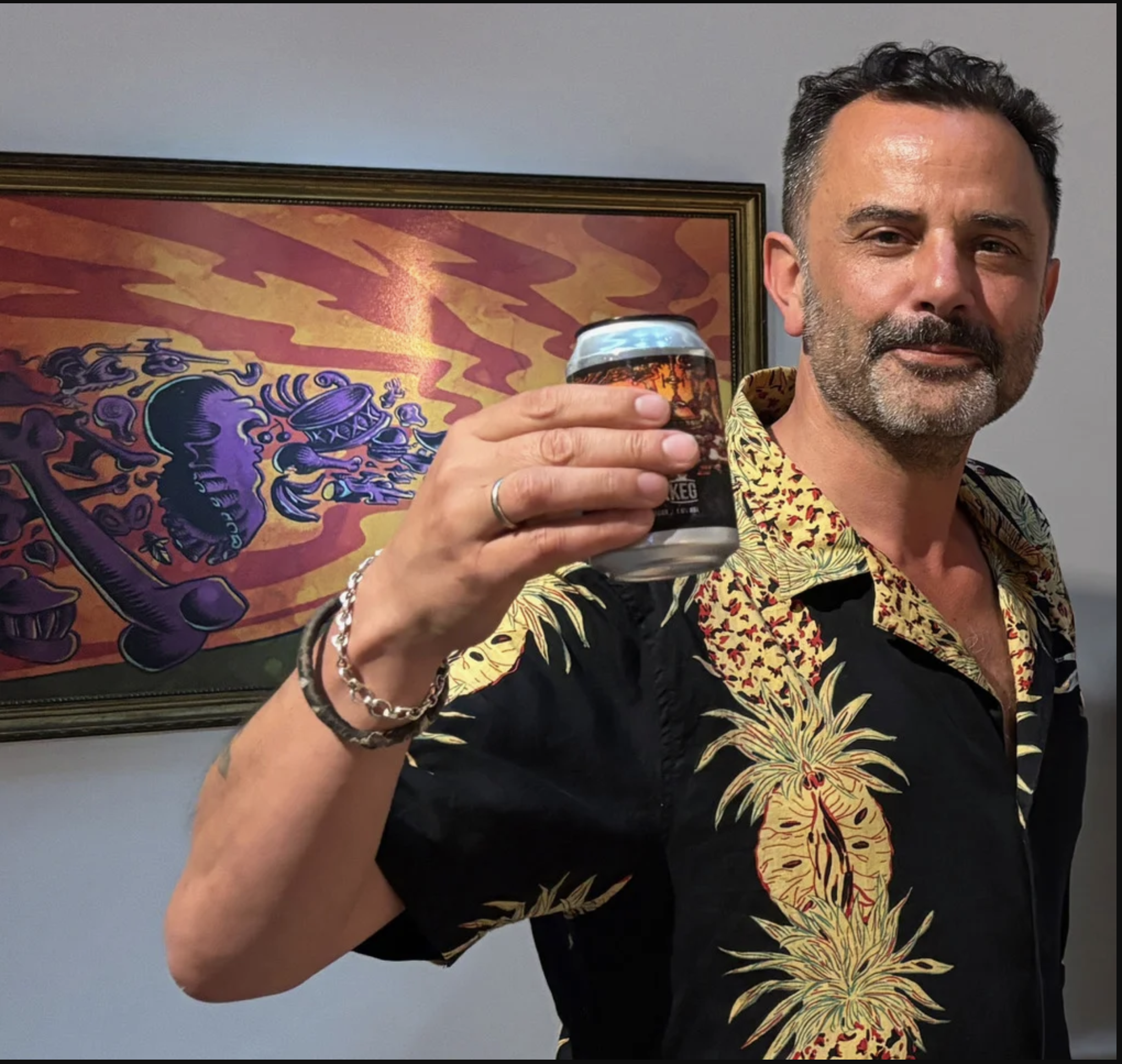
Jem Stone Panufnik is a London-based producer, DJ, and visual artist — co-founder of Finger Lickin' Records and the creative force behind the label's iconic sleeve art. The son of classical composer Sir Andrzej Panufnik, Jem grew up attending London Symphony Orchestra rehearsals before finding his own path through funk bands, acid house, and the emerging breakbeat scene. He co-founded Finger Lickin' with Justin in the mid-1990s, designing every record sleeve while co-producing tracks as Soul of Man.
Under various aliases — Soul of Man, Bush Doctors (with Rennie Pilgrem), and his own name — Jem has released music across house, breaks, and funk for over two decades. His latest project, Captain Carnival, is a 96-page illustrated book paired with an 18-track album, published by Velocity Press on his own Bonafide label. He continues to create art for the Space Cowboys and the wider breaks community, and Finger Lickin' Records has returned with revival events and festival takeovers.
Origins: A Classical Composer's Son & the Black Sheep
I am happy to be here with Jem Stone and if I could say your last name right, Panufnik. Artist, DJ, producer, musician, Jem Stone, Soul of Man, Bush Doctors, co-founder of Finger Lickin' Records, and as of recent, a music art book, Captain Carnival.
Well, welcome. Welcome to the podcast.
And just before we even start I'm repping artwork that he did for the Space Cowboys ripe cast so I'll plug that as well. And I should mention that I have three pieces of your art hanging in my house and the only ones that I actually have hanging so you are a hundred percent of the art hanging.
Well, I'm honoured. I saw them behind you interviewing Coombsie and I see them once in a while. So yeah, I'm honoured and proud.
Yeah. So we'll dive in and let me ask the question I ask everybody. What was music like for you growing up in your household?
Well, it was quite unconventional. My dad was a classical composer and he had very sensitive ears. We were sort of brought up from a very young age to be really quiet around him. And also like other people's music was poison to him. We'd be in a restaurant or in a lift or something and we could see him flinching with other people's music. So I grew up in the habit of really hiding my music from him because music was taken quite seriously in the house. I mean it was a big thing and a pleasure but it was quite serious. We'd never have music on in the background, we never had music on in the car. But everybody, my sister, everybody, we were all really passionate about music.
I had a very musical upbringing, so I was very lucky. He worked with some of the greatest orchestras, London Symphony Orchestra, Yehudi Menuhin, and Andre Previn, some amazing musicians and conductors. And I went to a lot of great concerts and I was able to sit in rehearsals and sit behind the percussionist, because percussion was my thing. I'm a drummer. And so that definitely ingrained itself in me, that sort of musical background.
I felt a bit of a black sheep of the family. My sister is a classical composer as well, and she went to Royal Academy, she was very academic and she learnt composition, whereas music, until I was probably in my 20s, even myself felt it was quite a frivolous hobby thing and not something serious until it started to get really very serious. Because of that, I think it took me a while to actually realise that I can do this. I mean, my mum still has no idea what I do and I can't even explain to her.
That seems to be a common thread. Lee Coombs said this, he said the same thing. He just kind of said like yeah I just did it to the point where I'm not doing anything else and I don't know if they ever really figured out what it is I do.
Yeah, well it's very abstract. I mean, me liking pop music and going that way, that was all very well and obviously very different. But getting into dance music where there's a whole other mentality and thought and function behind it.
So it sounds like, referring to how your dad listened to music. So was music like a very intentional act, when you were listening to it, was it very like a focused session around the house?
Well, for him it was. He would sit and listen to the radio like we would sit in front of a movie. And sometimes he could sit down with a score and read it like a book, an orchestral score. So I kind of witnessed this and I witnessed the sort of gravity of it. I was really passionate. I got straight into buying records as soon as I realised you could. And my passion, as I said, was the drums. And so my parents, when I was about 10 or 11, got me a drum kit, which I think was the most amazingly generous thing under the circumstances.
My practice times were small windows, but I was able to pursue that and I was in bands all the way through my teens and through my twenties.
Do you remember the first music? If you were having to get music and not necessarily listening to it around your parents, what, do you remember the first music you started to fall in love with and records you were buying?
We did always used to watch Top of the Pops. It was a real institution for everybody. I mean, you'd go to school the next day and everyone would talk about what was on that night before. So I remember seeing that from a very young age. There were lots of tracks that really stand out. I remember specifically because of Blondie, who I was madly in love with.
I really remember seeing the video for Heart of Glass and that was when she chopped all her hair off. That must have been 78 or something. And so I was eight or nine and I was like, wow. David Bowie. Yeah, lots of things really. Laughing Gnome, actually, by David Bowie was an early one.
We had some dear family friends who worked with my mom and lived with us who introduced me to a lot of music and we always had music on in the car. The husband worked with Stiff Records. There was a lot of early Madness and that kind of thing. And actually that was where my love for stickers and posters came in because you'd get lots of ephemera from record labels you worked with. I started collecting stickers and posters and things like that.
The first single I ever bought was Visage Fade to Grey. And I think that was probably 1980 or something like that. And so I was very into that sort of electro sound. Depeche Mode was quickly after that and all that. So as a drummer, I actually got into drum machines and that sort of sequenced syncopated kind of sound. And then I turned my back on New Wave and Japan and New Romantic. But then when I became a teenager I was really into punk. I was massively into The Clash and rockabilly stuff, Stray Cats.
I sort of then worked my way through and into acid jazz and then funk and then house and then breaks and then all of it.
From Bands to Beats: Four-Track Days & Art School
At what point did you start producing, DJing, releasing music? Where did you hit your point where you started becoming more of an individual artist?
When I was a teenager, I had a little four-track cassette recorder. So you could record literally just four channels. Really crappy. Channel one was panned left, channel two was panned right, three and four were panned central. So I'd end up making these things and I'd have to bounce and bounce and bounce. I got really into recording and I was just doing stuff on my own. But I was just playing around. I had no aspirations at all. But through that, I got really into just recording gear. I was really into outboard gear and the recording process.
So as soon as I could afford it, I bought an eight-track reel to reel and a 12-track desk. I started recording, was in a funk band and we started doing recordings and I was doing some stuff on my own. The sequencing side and the fact that I could sort of overdub and work things and loop things. The whole recording aspect and just getting off on making great sounds and enjoying effects and reverbs and things like that. That was my sort of inroad. I spent years just noodling and making stuff that just stayed on a cassette in a shoe box.
Art was really my thing when I was growing up. That's what I really thought I was going to be doing from a very early age. I went to art school, I did a degree in graphics and animation at Camberwell in London. And that was the point I was about halfway through my course when I suddenly realized, actually, I'm not really enjoying the art at all. I'm really getting a kick out of music. That's what I want to do. My mum was like, don't drop out! Finish the course, just finish it, and then decide. I finished it. I was gigging with my band, putting on funk nights, making flyers for them. And I could just start to see this sort of path.
For years I was sort of torn between the art and the music and thinking I had to decide and it wasn't really until Finger Lickin' that I realised actually I could do them together.
Meeting Justin & Building Finger Lickin' Records
They were called President Groovestone. My claim to fame actually is that our rhythm guitarist was a certain Simon Ratcliffe who went on to start another little beat combo called Basement Jaxx. So he went off and did real seminal house music. And I was their percussionist. We did a UK tour around all the clubs and I was their bongo player with big hat and shades.
The turning point really was meeting Justin. I met a guy who ran a label called Sultana who were doing very sort of US-style house music. He saw something in what I was doing and he bought me an Atari 1040 for 130 pounds. So I then started to sequence stuff. I was just getting into house music, just starting to go clubbing. I was a massive fan of Masters at Work and the jazzy, soulful side of house. So I made a track for him, a kind of funky jazzy house with a really deep house mix on the other side.
Then I met Justin and I was just starting to make house music and sequence beats. He was working for a record label called Havin' It, which were just sort of starting to license house tunes and make compilations, like Ibiza compilations. A friend of a friend hooked me up to do some artwork for some of their sleeves. And that's where I met Justin. We got chatting. I had this little studio and Justin's one of these can-do people. He was like, we could use that. Before I knew it, we made a couple of tracks, took them to the studio, mastered them and pressed them to white labels and they sold and they funded the next load. And the whole thing sort of started going.
And so was that the point where Finger Lickin' was born?
We probably must have done about four or five tracks as Rushmore and Panufnik. Justin then started Vinyl Addiction, the record shop, and we were both really aware of this emerging sound just bubbling away, people like the Freestylers. There was no name for it really. It was electrifying because I'd been DJing funk for years and I had a massive funk collection. I could hear all these tracks and go, I've got that sample. And it had those sort of house music sensibilities and it was kind of scruffy around the edges, which I liked.
We thought, well, if we start to do this new thing, let's do it under an umbrella. When we started Finger Lickin', it was really a vehicle for us to experiment. The first few tracks were all different tempos and different styles. Some were quite jungle-y, some were quite funky disco-y, some were kind of electro. We were just dipping our toes into little things, all under this Finger Lickin' umbrella.
Another guy, Duncan Scott, was one of the guys very early on. We used to do a night, the three of us, down at a venue called the Dog Star in Brixton. It was a great sort of place for teething new tracks, just trying things out. We played funk and Duncan played the hip hop and then we mixed in a bit of breaks. And it was already wild on a Thursday night. It was a real breeding ground of breaks and just that sound. As new tracks would come to Vinyl Addiction, we'd take them and play them that night and see how they went down. It was really exciting times.
It was totally organic. Nothing was contrived. We weren't trying to be part of a scene. There was no bandwagon hopping. We were just really getting off on and enjoying that sound. The funk thing really was the thing. Justin used to say, get the ladies dancing and everyone dances, and it was true. We always wanted that kind of party vibe. We never took ourselves too seriously.
It was just meant to be a vehicle for me and Justin. But Coombsy appeared, he was the van driver for one of our distributors. Justin and me heard him, we're like, that sounds like Finger Lickin'. We've got to have that. And then equally with Robin and Jason, the Plump DJs, straight away with Plumpy Chunks and Electric Disco, that's Finger Lickin'. But I know they all came to us because we were doing the funk thing. All these other break labels were quite masculine on the whole. We were doing really well with our sound and we had that kind of family vibe.
Fatboy Slim, Genre Wars & the Break Scene's Peak
First time I ever heard a DJ, apart from me, play one of my tracks was Fatboy Slim at Glastonbury when there used to be just one dance tent. Back then, it was a tent that fit about 3,000 people. It had been raining so everybody was in there. And he was just massive, just exploding about 99. This track started going, I know this, I really like this track. And it took me about a couple of minutes to go, that's my track. It was Between the Eyes. I did that with Flynn, with Jay Chappell and Andy Glare. We did that in my little bedroom studio with a Juno, a sampler and the Atari. And there was Fatboy Slim playing this track to 3,000 people and it's got a massive breakdown. I was there watching, I couldn't even tell the people I was with. I was just soaking it in. Even to this day, I'm not sure if I didn't actually dream it, but it was incredible.
I always thought of that sound, like you said, it didn't take itself too seriously. It didn't have to be funky, but yes, it was more prone to the samples or a little funk, a little humor in it. And then there was the other side, which was kind of the new school breaks, which I thought of as more serious, a little more grindy, a little more metallic sounding.
Yeah, I was always a bit scared of all that lot, like Rennie and Mark Pemberton and everybody. It was a bit like, they were a bit tough.
It was all a learning curve. When we started Finger Lickin', we didn't have full colour sleeves. That was probably about the 10th or 11th single that we started going, actually, we could do this. I'd never really used computers. I'd done stuff for print, but I'd always done it by hand. So I was learning on the fly and learning how to make stuff print. I get something, a Plump track, Blackjack or Creepshow or something like that, straight away I knew what I could do. I've always liked to tell stories with my art and the music. Not just do straight up a track or a sleeve. I like a sort of narrative, something extra there to put you in or something to follow.
The artists I was really into as a kid were like Gerald Scarfe, who did Pink Floyd's The Wall. He did these amazing caricatures where transmogrification is the word — he would do Chairman Mao as an old armchair or Margaret Thatcher as a pair of scissors. He could draw Nixon with just a jowl and a sort of line, just two lines where you could see straight away who it was. And from San Francisco, the psychedelic poster art, people like Victor Moscoso and Rick Griffin. It was a real mecca when I came to San Francisco first time because I worship all that stuff. Blending in a really psychedelic trippy way different images and typography and colours. Both those things were a big influence on me.
I used to bring funk, old 70s stuff. And I realized bit by bit there was a whole section of my record box I would never actually get to because the guy doing the warm-up was playing my tracks and playing them plus five. I got really fed up. We used to love just dropping a house track in the middle of a break set and people would go off. But it got very specific. Actually in Australia, people would get quite cross if you played a house track. I remember someone literally coming up to me and going, if I wanted to hear a house track, I'd go to a house night. And I'd be like, well, off you go. It got faster, it got more production based. I like scruffy music really. I like it when it's a bit loose.
Probably about 2005, 2006, I was certainly feeling a bit disillusioned with it and by seven or eight I definitely wanted out. You get very blinkered in your taste and your access to music. You're only really listening to stuff that you can use in your set. You're only buying stuff that you can use in your set. I really felt like I was just using one part of my brain and there was a whole other side that just wanted to get back to where I was 15 years previously, noodling.
Soul of Man, Collaborations & the Production Process
So when you were working on tracks, whether it was with Justin or as Bush Doctors or releasing as yourself, how did that come up for you? Did you have a sense of this sounds like a track I would do with Justin?
It's just about jamming, really. With Justin, he would bring some tracks, generally old hardcore, 88, 89 sort of house and breaks. We would sample, spend an hour in the morning just going, that sounds really cool. We'd grab little vocal dubby snippets. And we might sample some bits and then we'd get a groove going.
I would chop them up and start to get a groove going and might smash in a bass line or try some bits. We'd have loops going coming out different channels on the desk. Justin might be punching things in and out on the desk. That's how we might arrange things. We were very interested in having this whole voodoo vibe going. It was always quite dark and B-movie-esque, but fun at the same time.
Justin didn't do any of the production or engineering. He was just directing with his punching in and out. I'd be moving chunks around on Cubase. Back in the day, before total recall on Logic, everything was going through a mixing desk. So all the channels, all the effects, everything was all in as we were writing it. Nearly all the time we would arrange something, write the track, and master it all within three or four days. We'd both be whacking up the delay, doing about 10 different takes and then choosing the best one. There were lots of mistakes, always leaving things switched on or too loud. So that's why a lot of stuff sounds really spontaneous and live. We did things that you could never recreate, little feedbacks on delay and stuff.
I like it. A lot of the music I like, I don't like anything that's too controlled. Same with movies. If you're double-guessing how they did it, you just want to get lost in sonics and be constantly surprised or intrigued.
Space Cowboys, Captain Carnival & Finding Purpose
As you were getting out of that era then, what's your life and career starting to look like? You're not enthralled with the DJ side of it already. What year did you come to San Francisco? What was that time when you had the art showing?
That was, I guess, so my oldest, who's now 14, was one or two. So it would have been about 12 years ago. What was lovely is that as I dipped out of the label, we all kind of went on and did our own things.
As that kind of stopped, I was still in touch with the Cowboys, notably Andrea and Zach, and they kept me involved in doing artwork for the Cowboy events. So I was able to keep my hand in doing stuff for the breaks crowd. I was doing stuff for the Space Cowboys. I was also doing the flyer art for Ghost Ship, which was that fantastic annual event, the Halloween party. I've been doing their artwork for 10 years or something. I think it was the 10th anniversary, where Andrew invited me out to do an actual installation there.
Murph has always been really supportive and very accommodating. He said, why don't you do a show while you're out there? So he helped orchestrate an art show. I came out with my wife, Misha, who's a digital artist, and we made this great big installation for Ghost Ship. In that week, I did a show in San Francisco, a venue called Monarch. It was a fantastic venue and we had acrobats and people on trapezes and all sorts of things. I was able to make prints. That was the time I'd got a lot of my old sleeves and printed them up. It was amazing to be there and put names to faces.
I knew Rennie and we took the piss out of each other. He was always taking the piss out of my funky breaks and me, his gnarliness. It turned out that he lived about three roads away from me in Shepherd's Bush. He's got a heart of gold and he's a really sweet guy. So we struck up a friendship and started making music together. Bush Doctors from Shepherd's Bush, that's where the name came from. It was just a pure passion project of listening to disco and funk and just having a laugh.
Our 20-year anniversary came up. We stopped releasing music at about 2007 or eight. We put on this boat party and I started an Instagram page. Very quickly, it showed that there was still a lot of love out there. It sold out immediately within 24 hours. It was such a success and we ended up doing an after party. It was so nice seeing all these old faces.
Captain Carnival. I've been writing and producing stuff under the name Jem Stone for quite some time, probably 15 years or more. I started to write this album in lockdown and I started to get a narrative in my head. I came up with this concept, the Legend of Captain Carnival. The captain ostensibly is this character, a sort of Ganesh-like, god-like figure, once celebrated and something incredible and magical, now forgotten, lost to time. So the album and the book is really about this journey, kind of Indiana Jones-esque, about discovering who he was. It's an allegorical thing about looking for your own mischief and magic, especially being middle-aged, being stuck at a job. All of us still have that spark. Captain Carnival essentially is that spark that we're all looking for.
There's 18 tracks on the album, so there's 18 chapters. They're all part of this journey where you're going through different emotions and temptations and emotional challenges. It got bigger and bigger and I actually frightened off the original label. Then someone had the idea to approach book publishers. I came across Velocity Press, who do amazing books about club culture. I'd almost given up hope. I sent it off and within about 15 minutes, Colin who runs it emailed back and he knew about me, knew about Finger Lickin'. He said yeah, I'll have it. So it's published on Velocity Press, and the album is out on my label, Bonafide.
I haven't actually chatted with Simon one to one for ages, but he was doing Shadow Maker at the same time as I was doing Captain Carnival. For all of us at our age, you kind of need a reason to do stuff. You sometimes sit down, the conditions are perfect, and then you get overwhelmed like, what's it for? I really related to what Shaq was saying about just having the freedom to create something that comes naturally to you.
Actually, first time I ever saw Shaq was when he was in a band called Flickr Noise. There was an Andy Weatherall night in Leicester Square. My mate said, come and see my mate Shaq playing. And he had long dreads and he was doing this really grindy sound. Years later, we were doing a gig together and the promoter said, well, this is different from your Flickr Noise days, isn't it? And I was like, you're not Flickr Noise, are you? And he was like, yeah. Then it turns out he's got a long legacy with Thom Yorke and a whole musical side none of us knew about.
That'll take us full circle because for 15 years, I sat here with this idea of, wouldn't it be great to have this DJ podcast. And it was in the pandemic when I just was not mentally well for a little while there. I lost the joy for music for a while. And the thing that I was having this existential question — how do you age gracefully as a DJ? And what I found was by refinding my joy in music, just listening to old albums, reconnected me. I'm going to sit down with vinyl and go and listen to it with a friend. And I just went, oh, OK. Music as a means to bring people together and tell stories. And so with that, we'll wrap up here because this is my way of telling stories through music.
That's a lovely way to end, actually. Just enjoying music, remembering why it is that you loved it, what it is that inspires you. Yeah.
100%. Well, thank you for your time. Thank you for all the art and music and all the goodness that you've put into the world. You've got a ton of fans who have enjoyed it over the years and we'll look forward to what you have next.
Well, thank you very much for having me. It was really nice catching up. Thank you for your support and everything. All right. Thank you.
All right, cheers.