- 01The invention of turntablism — “no schools, no YouTube, no internet, we're just making it up as we go”
- 02How the Rock City DJs became the first turntable band and, from there, the Invisibl Skratch Piklz
- 03How Wave Twisters became the first animated hip-hop movie — and how its animators effectively invented After Effects to finish it
- 04The reverse / “hamster” switch, the thin O6 mixer, and the QFO — the crew's inventions that ended up on DJ gear worldwide
- 05The thesis of the whole episode: “the ultimate happiness is in giving” — Scratch University and open-sourcing the craft for free
- 06DJ Muggs on respecting your gift, the “two of theirs, one of mine” set formula from Mix Master Mike, and music as “the language of God”
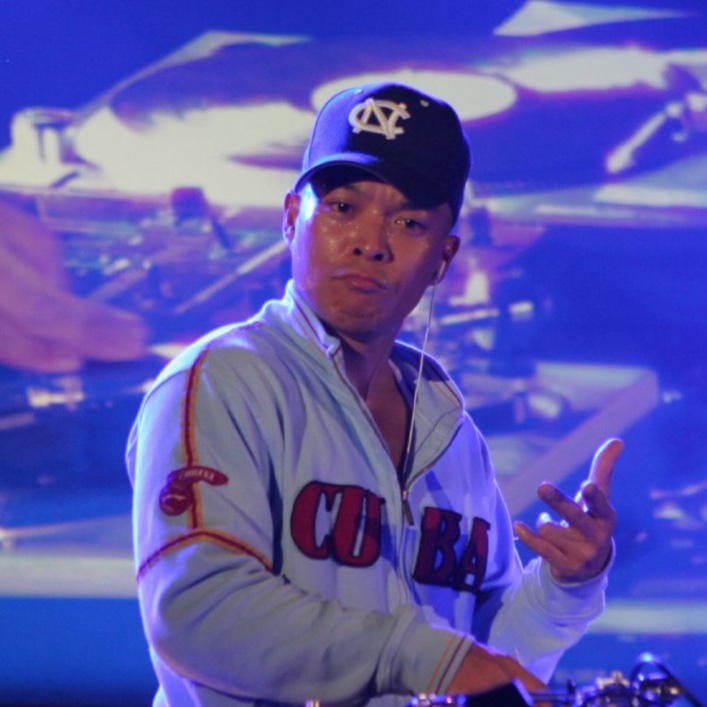
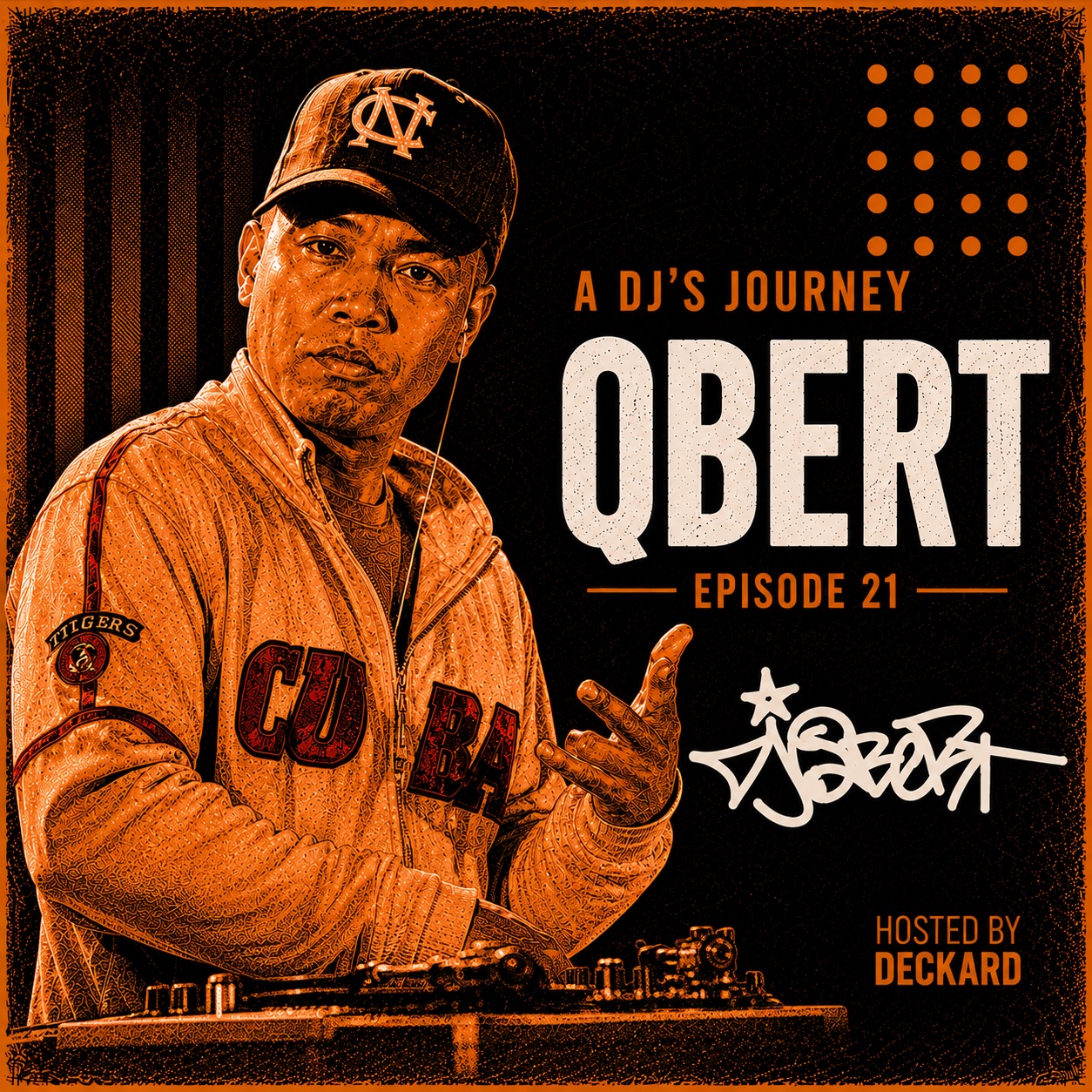
DJ Qbert (Richard Quitevis) is the most decorated turntablist in DJ history. A Bay Area kid who started scratching at fifteen — “no schools, no YouTube, no internet, we're just making it up as we go” — he came up through the Filipino mobile-DJ crews that built West Coast DJ culture, took back-to-back DMC World titles, and was eventually asked to stop competing. From there he co-founded the Invisibl Skratch Piklz, the first band whose instruments were turntables, and made Wave Twisters, the first animated hip-hop movie.
Through Thud Rumble he's put the reverse “hamster” switch, the thin O6 mixer, and the QFO onto DJ gear worldwide — then given the craft itself away for free through Scratch University and the Wisdom of Wax series, because “the ultimate happiness is in giving.” Find him at djqbert.com, on youtube.com/thudrumble (Wisdom of Wax), and @djqbert on Instagram. A DJ's Journey is the oral history of dance music, told by those who created it. For more, subscribe to The Crate Letter — adjsjourney.beehiiv.com.
Short-form highlights from the DJ Qbert conversation. People can find the episode through YouTube, then land here for the full interview, transcript, and links to every platform.
Read Full Transcript ↓
Turntablism, the Invisibl Skratch Piklz & the Universal Language
All right, welcome. I am Deckard. This is another episode of a DJ's Journey. I am very pleased to have on none other than turntablist legendary turntablist Q Bird. Welcome.
Yo, yo, yo, how's it going?
It's going great, man. Happy to have you on and happy to have you representing the turntablist area. So I'll just dive right in. When you were a kid, what was music like in your household?
Yeah, thanks for having me. Well, I mean to start off, my mother said when she would play classical music that I would kick in her belly, so that's the first thing. And then when I was a kid, when I did finally hear music when I was out of the womb, I definitely did like classical music a whole lot. And I guess as I grew up she said jazz would be like the highest form of music and classical, so I started listening to a lot of that. And then when I got into music I always liked the more weirder music that was not commercial or not mainstream. I always was like, whoa, this is some weird radio stations out here that have strange type of music that not everyone listens to. I always veered towards that. And then finally hip hop came around and I was like, this is dope. And I started learning how to scratch, and then I found out that was a musical instrument. I guess jazz and classical, those are the things that really influenced me the most, and being that I liked weird music, all of that combined into one kinda formed my way of thinking.
At what point did you get into — when did you know you wanted to DJ? And did you play instruments as well?
I tried a little piano and violin and what else was there? I think that would be it. And then, but yeah, when turntables came around and scratching came in, that was just like, whoa, that's the weirdest sounding stuff of all things and I didn't even know that it was a musical instrument. I was just like, that's weird, I like it. And I was about fifteen years old when that happened. Kind of like in the breakdancing scene — I tried to break dance and do a little graffiti and all that. The scratching started me off in the DJ world.
Did you have a mentor that introduced it to you, or were you just drawn to it yourself?
I just did it by experimenting. Then I had friends around the neighborhood that did it and we all kinda threw it back to each other like, you do too? Yeah, me too. Look, check it out, look what I can do. And we would learn from each other 'cause there's no schools, no YouTube, no internet. We're just all making it up as we go.
Do you remember the first records you bought?
I mean children's records, you know, with the Superman and superhero stuff. Then after that was fairy tale stuff and whatever — Jack in the Beanstalk, you name it. All those weird kid records, I collected all of them. But as far as music, I'm gonna say Rapper's Delight would probably be one of the very, very first ones that I can remember. And I couldn't get Rapper's Delight 'cause it was sold out. So they gave me this other thing called Funk You Up by Sequence. It was Sugar Hill Gang's female rappers. And so that was cool. That was my very first record, I would have to say.
When you started learning to scratch and DJ, were your friends into a similar style as well? Was that what was around you?
Yeah, like all the rap songs had DJs that would scratch — they were like the guitar solos of the rap songs at the time in the eighties. And so we would always listen to that part, like, listen to that. That guy's doing whatever, I don't know what the heck he's doing. And we would try it out and kinda experiment and be like, that's what he was doing.
How long before you were playing house parties, or, you know, getting into scratch battles? What was your progression like?
Kinda right away, because all my friends knew that I would collect all these weird hip hop records, and my friends said, I have one turntable at the house, and we were like, let's bring our records over there 'cause he's got one turntable. And now all the kids would break dance, we would play the record. When the record is over, you take the record off, and there'd be silence and everyone's just yapping and there's a bunch of kids all talking. Then you put the next record on and it's like, ooh, I like that song. They'd break dance and spin around and they had no control in their legs would fly everywhere and hit the turntable box, and it was awesome.
And how long before, as far as your involvement in crews and getting more collaborative — what was that like for you as you just kept diving in?
I guess my high school friends started with me. We had a crew called Live Style Productions and then we were DJing. We kinda figured it out — okay, you need two turntables and a mixer — and we would go around and do parties and little high school dances, and we started getting a little notoriety. Then we started doing proms and all kinds of parties all over the whole Bay Area. And that was in like nineteen eighty five through eighty six, eighty seven. Eighty nine, ninety, ninety one — all that whole time period, those five, six years of my start, we were mobile DJs.
What was the scene like back then? I've talked to DJ Dan and he talked about what the rave scene was like in the early to mid nineties. I'm curious what your experience was like with your gigs.
Yeah. In those times we were doing mobile parties, and they were like these miniature raves. We didn't even know what a rave was until about the early nineties, or late eighties. And I guess in the nineties, when I started winning major competitions, I started doing more like DJ kinda hardcore scratching routines, and they would hire us for raves and things, and we would just play, you know, a lot of electro stuff and b-boy type hip hop and all kinds of stuff. Anything related to hip hop at the time. So it was pretty much electro or breakdancing music, electro funk, hip hop — the hip hop in the early nineties. And it was almost like at the time it wasn't even on the radio yet. Like it was totally illegal to play that stuff on the radio. And we were kinda like one of the first crews, the Invisibl Skratch Piklz. We were known as Rocksteady DJs at that time, because we went to New York and did a show out there with our rap group, and then the Rocksteady crew — Crazy Legs and Ken Swift — they all saw us and they're like, damn, they're doing a crazy ass turntable band thing that no one has ever seen before. And then we became the Rock City DJs — DJ Apollo, Mix Master Mike, who's the DJ for the Beastie Boys, and myself. And that was the first turntable band.
And at what point did you guys get aligned for the Skratch Piklz?
Woo, let's see, that was — we started doing the turntable band thing, I would have to guess around nineteen ninety one. And then from there, we went to the DMC competition and we got lucky and won because we already were doing team stuff as a turntable band, and they had just started doing that, and we were like, we got a head start on all these guys. So we won that world competition from nineteen ninety two and then nineteen ninety three, and then nineteen ninety four there was no battle, so we kept that year.
Can you talk to me a little bit more about that idea of using turntables as being part of a band? Where did that idea come from? It seems like you guys gelled together quickly. Was it a lot of work before you gelled?
Well, to us, one of the hardest things to do was drum scratch. So we did a lot of drum scratching. And it was like, okay, well if you're a drummer then you could scratch other things, other musical instruments, and it became a turntable band. One guy would scratch a bass line, one guy would scratch guitars, vocals, anything, whatever. And it became a very unique sound. So we were doing that for a bunch of years and then we finally figured out we need our own name instead of being Rocksteady, which is tied in with Rocksteady crew — which is cool, those are our homies — but we needed our own identity. So we came up with Invisibl Skratch Piklz and other members came in. D Styles, Shortcut, Flare, Yoga Frog, even Tom Cat was an honorary member. DJ A-Trak, who's Kanye West's DJ. There's a lot of guys in the Piklz.
And how did you guys collaborate? Was it just sort of whoever's around, or did you have particular projects and routines you were working on?
It was pretty much who were the top scratchers. I mean, we couldn't get all of them in — there's some guys out there that weren't in the crew but they were top scratchers like Quest and Eddie Def and all those guys, Bulletproof Scratch Hamsters. But it was mostly the guys around the hood that were in the crew. At every DJ battle there was always these top guys that would win all the battles in the Bay Area, and we all kind of were like-minded and we all became crew members.
It's interesting how you guys being of a similar taste and mind helped create a scene and transmit that outward. What was that like when you guys were going to DMC and then being asked to not compete, correct?
We had been doing it for so many years, it was almost like the universe saying, all right, that's enough, come on, move forward. So we got out of it, we became more of like judges and stuff. And I was like, what can we do with this energy? We got this battle energy. So I went on to make the first ever animated hip hop movie, which is Wave Twisters, a movie. Every song in my album, Wave Twisters — my first album — was a chapter in this movie. And I was like, well, what about if we animated all these graffiti characters that are on the walls around the Bay? How come there's no cartoons of all these dope ass characters? So we got Doug One, who's one of the top graffiti artists in the Bay Area, to do all the characters. And then we ran into some animators — they work for Apple now, Sid Guerin and Eric Henry. They were so advanced they had to make an animation tool called After Effects just to make the movie. So they invented kind of like After Effects. I don't know if you ever heard of it.
And for those that are watching or listening and don't know — I had that DVD, by the way. I looked it back up again and was taking a look at it and was struck by, if I'm not mistaken, the album came out first and then you animated everything to the album, right?
Yes, the idea was there though. First, I had to make the album first, which is gonna be all the music, and then we animated the storyline and it all came out.
How much of that was in your head? Did it just feel like a natural extension to make an animated version?
That was the first thing. Yeah, if I make the album, I'm gonna make a movie as soon as the album's done. So it was already part of the process.
Was that your first movie or project of that scope?
Yeah, for sure. Definitely.
And how rewarding or painful was it?
One thousand bazillion percent more rewarding than anything. It was like, couldn't believe that it happened. I was like, wow, we made the first ever animated hip hop movie.
You seem to have a love of sci-fi and the cosmos. How do you feel that connection with the music and with what you do?
I love anything futuristic. Like scratching to me is futuristic. It's not even supposed to be a musical instrument, but it is, and it makes really futuristic sounds. I've been obsessed with alien life and extraterrestrial life on other planets ever since I was a kid, way before I was scratching. And I was always into what is running the world and all this stuff. So the whole movie is about that type of thing happening — the powers that I call the powers that were, 'cause they're not really in control anymore. For a long time they were trying to take away art in schools, they were trying to hide hip hop, they would always just play what they want on the radio. That's what Wave Twisters was about — they're hiding all this amazing art and taking it out of school programs, and they wouldn't encourage you to think out of the box or be curious. I call it the hypnosis machine, the television and their media.
I'm curious if you have any — the recent government putting out UAP, making more of that publicly available — are you watching it with apt interest?
Of course. Absolutely. And that's why I call them the powers that were, because now the powers are with us. Now all this information is coming out. It's like we're going into this beautiful age of being able to go out into the universe right now. It's amazing.
So you had a major hand in developing hardware. Talk to me about what that experience was like. Was it similar to the animated movie — could you see it in your head what you wanted? Did you have to learn a new design language?
For sure. Those guys, they develop everything. We just throw ideas at them. We already knew that anything is possible. When you know that God is inside of all of us — God is the most powerful thing and it's inside everybody — so why not use your power of God to be like, yo, anything's possible? I want this on the mixer, boom boom boom, let those developers fix it. And they do it. Big shouts to Vestax, that company. They made a lot of different contraptions on mixers that we had invented throughout the years.
What can you remember from the beginning that you had in mind that was missing at the time? What were some of the evolutions you were looking to make?
Well, on a lot of mixers we scratch backwards. You know how Jimi Hendrix would play the guitar backwards? But then if another guitarist wanted to borrow his guitar, it'd be like, damn, the strings are upside down, so we can't play it that way. So we developed this simple thing, a switch that would reverse the crossfader direction. In the Bay we call it the hamster switch. And then they put that in there, so now all mixers have that. Later, the mixer was too big — it's hard to do tricks with the mixer so wide — so we made a mixer really thin called the O6 Pro by Vestax. Then we were like, what about the up and down faders? Let's put those in reverse too. That was the O7 Pro. Then when I was at the beach in Hawaii, I'd see guys playing their guitar or flute on the beach, and I'm like, I can't scratch on the beach yet. So let's make an instrument with a turntable and a mixer all in one piece, and I plug it into my car, and now I can scratch at the beach. That was called the QFO. And everything's in stereo — what if we had surround sound? So we invented a little joystick, and the scratches would fly around you. There's so much — there's infinite things you could do.
That's awesome. Are you still involved with hardware at this point? Are you still making new models?
Yes. We're always developing and designing things. There's a lot of things I wanna talk about, but let's wait till it comes out. I wanna surprise people.
Fair enough. I want to jump back for a second. You mentioned earlier, after the DMC championships and being asked not to compete, you made Scratch University, right? Tell me a little bit about where the genesis of that came from.
Well, there's this thing in hip hop where you're not supposed to show the secrets, right? But I was getting more into spirituality, which was like, if you give up secrets, it comes back to you. Or if you give, it helps others, it comes back to you. The ultimate happiness — I always wanted to know what is the ultimate happiness? And the ultimate happiness I found out was in giving. If you help others, it comes back to you. It feels good when somebody smiles — you give them a gift. So I was like, all right, I'm gonna teach people how to scratch for free. I put out everything for everyone. I even have a YouTube channel, youtube.com slash Thud Rumble. There's a show on there called Wisdom of Wax, where I have like hundreds of secrets for free online. And it's made me very happy. Ultimate evil is greed, so I don't wanna be evil. Every time I put something out there, the universe or God gives me a new scratch. So I'm like, this is a great little trick. Let's keep on doing it.
So you're giving, and in return you're essentially helping receive — a virtuous circle, I guess.
Yes, exactly. It's like if you don't believe in karma, I really feel sorry for you. It's a wonderful thing when you figure it out. It's that simple.
So from someone who's a good-karma guy — you're one of the best at what you do. A couple of my guests — Krafty Kuts, who's a DMC champion as well — shout out to Krafty Kuts, he put you and Mix Master Mike and a couple others on another level. I can't remember his exact wording, unimpeachable or something like that. What's that mean to you when your colleagues, other professionals who are good, think of you that way?
It's great, but I don't let it get to me. I know some guys that I've had some experience with, friends that are like, yeah, everyone tells me I'm so good, and so they stop practicing. That's the wrong thing to do. You gotta be like, okay, thank you, but it's time to move on. Let's keep going forward. There's no stopping, even if someone gives you a compliment like that. You gotta be really stupid to stop and be like, I don't have to ever practice anymore, someone said I'm good.
So from the DMC championships, where does your career take you at that point? I assume at some point you're starting to tour around the US, if not the world.
World for sure, yeah.
What was that like for you? Was it just a natural progression? Did you have any challenges along the way?
Just more like thanking God. Every second, I'm like, man, thank you God, this is awesome. And I did notice one thing — when I stopped practicing, you get a little bit like, I don't need to practice no more, and everything kind of falls apart a little bit. But then when you practice again and keep going, everything goes right back to perfectness. It's really interesting. You got to respect your gift. If you don't respect your gift, things will just dwindle away. I've seen that with a lot of colleagues. DJ Muggs had taught me that — DJ Muggs from Cypress Hill. He was like, you got to respect your gift, man, and keep helping others with your gift. You're a shaman. You're here to heal people. What the fuck are you doing? Let's go. It's cool to take a little vacation, but if you vacation, vacation, vacation, now you're abusing it, and your gift can be taken away. You're stopping the karmic cycle. You're stopping the giving.
What was your evolution going into the early to mid two thousands? I can't remember what year you guys stopped performing as Skratch Piklz, but were you going out more on your own, or still doing a lot of collaborative work?
Collaborative work and on my own. And we still do stuff with the Piklz — the Invisibl Skratch Piklz, big shouts to Shortcut and D-Styles. We have a new album coming out in a couple of months. It doesn't stop. I even heard Apollo and Mix Master might do a little guest appearance. But yeah, I even did stuff with Dan the Automator and we made an album called Dr. Octagon with the MC Cool Keith from Ultramagnetic MCs. My friend was like, shit, you were the DJ on that? A lot of people don't know that.
Yeah, I saw one of your shows here in San Francisco when you guys were here. That was great.
Man, Keith is awesome. Big shouts to Dan the Automator, the producer.
And very prodigious. A guy who talked about reinventing himself and taking on personalities. What's it like working on the Dr. Octagon project?
Super easy. They did the album. Keith did all the raps on Dan's music — I guess the music came first and Keith rapped on top of it. And then I just threw a little icing on the cake with the scratches, and that was real easy.
Do you have a preference for when you're playing out these days? Do you like the challenge of playing festivals? Do you like playing more turntable-oriented, battle style?
Now I just mix it in. It depends — if it's an audience that really knows who I am, then I can really do my thing and go off. But if it's an audience that doesn't really know what I do, I'll play a couple songs they'll know and do a little remixes. They like to hear familiarity. We call them sure shots — music the whole audience is gonna know. Not the corny ones, I like playing the ones that I like. Usually it's two to one — I'll play two of those, remix them a little bit, and then on the third one I'll play something way off the wall that still goes with it. Two of theirs and one of mine, and I'll keep them sucked in the whole time. That's the formula. I learned that from Mix Master Mike, watching him do parties — he would play stuff everybody liked and then throw some wacky stuff that he loves, and it just works perfectly.
Right. And you've played a couple of the Space Cowboys parties, and I saw Cut Chemist do a very similar thing — time and place, he threw down House of Pain, Jump Around, and the whole place is just going nuts. As far as what's on your plate right now, are you playing regularly in the Bay or mostly traveling around?
I just got back from Chicago. There was this meeting for the NAMM show — the music marquee show. I just got back from that, and then I gotta go to Mexico in a couple days, Puerto Vallarta or Cancun, and then I gotta go to Tuscany, Italy after that. And the Invisibl Skratch Piklz album is almost done and they're working on a world tour for that. Last month I was all over Australia and a bunch of cities in Japan and Thailand and Singapore. It's always all over the world in a strange way. And two, three weeks ago I did something at City Hall in San Francisco for a b-boy battle.
Can you tell me anything about the new album coming out? Anything you wanna preview?
We've got a lot of special guests on that. I can't ruin the surprise. The guys are gonna be like, shut up, don't say anything right now. Just say it's coming out.
Any other projects you're also excited about?
Man, tons. Every couple of weeks we come out with a new DJ tool record for the DJs — sound effects to scratch and that type of stuff. If you go on djqbert.com right now, you'll see the new Super Seal records that are coming out. And we have a club in San Francisco right at SFO Airport. It's called the Octagon. It's about twelve turntables — we used to call it the dungeon of death, now it's Turntable TV Studios. A big old octagon table with all these turntables on it, and DJs from all over the world come there because it's right at SFO. They land at the airport and just walk. I should call it the Walktagon. I'm a student there too. I'm learning from all these guys, because everyone scratches different. It's almost like a signature — like in the graffiti world, everyone tags their name different. You're drawing the sound, so everyone's gonna sound different. I'm over there absorbing what everyone's doing.
And we produce beats. We have like a hundred albums on djqbert.com for free. Each album has about seven beats on it, so it's like seven, eight hundred beats for free. Just go on djqbert.com and type in unreleased and you can download a hundred albums for free. They're just blank beats — you can scratch to it, if you're an MC you could rap to it, if you're a b-boy you could break to it, if you're an artist you can do graffiti to it. We give it out for free, it comes back to us.
Your repeated pattern of giving in multiple ways — across what you do and into the gear — that's awesome that you're so inclined that way.
It makes it so much fun. Or you can worry about, I'm not getting paid — I laugh at those people. It's much easier. Just put it out there and the universe rewards you. It's awesome. I love it.
Do you get into doing Twitch, live streams, that kind of stuff?
All the time. I'm on Twitch at least every other day or every three days. And YouTube, I do a YouTube thing at least once every three days.
One of the themes from the business side for some of the DJs I've talked to was a real need to adapt with the times. On the breakbeat scene, after post two thousand five, there was a huge dive in record sales. Did you struggle through that business side with vinyl?
Vinyl did take a little bit of a dive, so we're like, let's do digital shit. Everyone's going there, let's go, we'll make our shit digital. That worked out and it's still working out. And now people want vinyl, so we do that too. So now we do both, it's perfect. And then you got the complainers — all the new innovations with AI and whatever. I mean, you see pianists, right? They use synthesizers, and you got the guys that are like, fuck these synthesizers. It's all good. Same with me — I got digital on this side, I flip it over and it's vinyl on this side. Best of both worlds. It doesn't have to be one or the other. But yeah, we do have a lot of haters. Anything new comes out, man, it's always the haters. I love it, it makes me laugh. It's like, fuck these toilets, I clean my ass with a rock, let's use leaves. Good, okay, I'm happy for you.
Fuck you for using your sync button. Don't use it.
Yeah, fuck that. Fuck matches, I make fire with two sticks.
So what are your thoughts about AI and using that in technology or in music?
I just made a post on my Instagram about those new Tesla robots. I'm gonna have one. These are gonna pack our records for us. They could do whatever you want. Clean my house, do my laundry. That way I can scratch longer. If you don't see the advantage in technology, I think you're a little bit off. If it's a fucked up day, I always look at — smell the flowers, wow, what a wonderful day, I can breathe. Some people can't even smell, some people can't even walk. I look at everything positive. Whatever new comes out, I look at the positive right away.
I just saw today there's gonna be a storefront opening up in San Francisco — they're trying to advance robotics by doing robot fights. Each person can bring their own robot and test out the new moves. They're doing it in a storefront so they can show people what the technology advancements look like, and get people interested in seeing these robots getting more sophisticated and freeing up our time for better things like scratching and DJing.
Sure, more time. Time is more expensive than money. Sometimes I have to watch myself — I'm scrolling and scrolling, and I better stop. Your time is worth a lot more than money nowadays.
As far as any of the hardware or ventures you're working on, is AI already playing a part? I was picturing a whole new world of digital effects — more creativity to create wild new sounds.
Absolutely. If I'm looking for a sound, normally you have to type it in, or if you're lucky you have your sounds in alphabetical order. It's like, fuck, where's that one sound? Now you just be like, yo, AI, I need this sound, and it'll find it for you. Quick style. AI can do a gang of shit for you if you're intelligent enough to use it.
Do you have any prognostications about where we're going with AI or future tech — with the DJ gear and turntables, your own thoughts on the future?
I'm sure you'll just tell it, I want my sound to sound similar like this, and then it'll just make it whatever you want it to sound like. Or get close to it at least.
As an artist, does it bother you that people could be going, I want my sound to sound like your sound?
Go ahead, but I'll be one step ahead of you, I'll make another sound. I'm not gonna stop at the one sound. Go ahead and sound like my ass a few months ago — I'm gonna make my sound sound different every time. If you keep your sound the same all the time, of course they're gonna copy you. But if you're into innovation, they don't know how to catch you. You're just doing all this other shit.
As far as how you keep yourself recharged — you sound like you have a good head on your shoulders with life and your energy and the community giving back. Do you have any trouble with traveling where you get things out of balance?
Sleeping is the main thing. When you sleep, you can really think a lot. I'm trying to sleep on the airplane, at the hotel, on the Uber ride — everything is trying to get as much rest as you can. I learned that from a guitarist, Buckethead. He was in Guns N' Roses — a really good friend of mine before he was in Guns N' Roses. I asked him, why do you sound so fast, like a hummingbird on the guitar? And he said, sleep — if you can get a lot of rest, you could be fast. So that's the secret. Stay healthy. So from that I was like, what else can you do to be healthy? I work out every day, I just came from a big old hike right now, eating right — everything I eat is organic, we go to the farmers market to get the right food. Everything's fresh. We bless our food. We go and harvest our own spring water. Everything is a prayer to God, to our food, even to our equipment. I'm always in search of health, because I'm a nerd at scratching.
Have you always been health minded, or did that come later?
Hell no. No freaking way. I was in the Matrix, man — McDonald's all day, Wendy's, Burger King, anything fast food, anything commercial, Coca-Cola, all the worst products in the world, until I started really getting into the alternative healing and alternative foods that are way better for you.
At what age did that kick in for you?
You can see it. When I was in the DMC World Competition in nineteen ninety two when I first entered, that was my McDonald's days. And the next year I started learning about it — you could see I had lost so much weight from ninety two to ninety three. Watch the comparison. You'd be like, who's that guy in ninety two, and who's that guy in ninety three? It's like it's my younger brother in ninety three.
I was reminded of a couple things. I was thinking back to my history of when I first encountered your work. I don't remember what the videos were called, but it was a video from the nineties, like home video, and you guys were in a room — Mix Master Mike had like a headlamp on. Turntable TV. And a buddy of mine who lives in Seattle told a little anecdote — you guys were so jazzed after a rave you played in Seattle, for USC, United States of Consciousness, that you requested somebody bring turntables back to the hotel room so you could scratch at four in the morning because you still had the energy.
Yeah, that's some John Coltrane stuff. We were getting into jazz music a lot and we learned John Coltrane, after the show, he still plays and practices. So we're like, we're gonna be like him and constantly practice.
I love it. That can be difficult to do when you're so jazzed and mixing it in with the sleep, but the creative energy wins out.
Yeah, when you're awake it's like, hey, let's use this to practice. When you're sleepy, it's time to rest up, for sure.
I mentioned before we hopped on the air that you're the first turntablist on. I've had representatives from Washington DC and a lot from the UK, and not so much from here. Does the turntablist style translate in the world? Do you find yourself having to change up what you do in any crowd, or are you able to do your thing?
Yeah, not really, because we figured out that music is a universal language and it's the language of God, and so we all know it. If you hear music, it's the same language. So when we're doing our thing and really feeling it, everyone else feels it too, because it's the same vibe. It's kinda like telepathy. Like for me, when I go to a country — I can't speak French at all, but I go to Paris and after two or three days I'll pick up the telepathy and I can say a couple French things. The longer you stay there, the easier you learn the language. You're picking up the wavelengths from everyone. Going back to music, when you're doing your thing, everyone's on the same vibe, so they know exactly what's going on. Any country I go to, I bust out some real crazy scratch flow, they feel it. We're all speaking the same language with the music.
Nice. You've mentioned in interviews before that scratching is almost like an alien language.
I mean, we're all aliens. If you do your homework, we're all seeded here by extraterrestrials or whatnot. It is what it is.
Aside from turntables, are there other instruments or expressions you've had?
I love art. Dance is another art — I'm not a very good dancer, but I like to watch it and I can see the language in it. And when I make drums on my samplers and drum machines, that's another expression. I leave the drawing and stuff to my friends. I have a really good friend, Mars One — have you heard of Alex Grey, the artist? Basically the world's number one psychedelic artist. Mars One works with him, and luckily lives in San Francisco and does a lot of work with me. And this guy East Three — he was taught by Phase Two, one of the number one graffiti artists in New York. I leave that part of the art to them. I'm definitely just the music guy.
Sounds like you're more than a music guy. What other music do you find yourself listening to these days? What inspires you or that you think is just good?
A lot of high level musicians I'll listen to — and more so than that, I'll read books about them or listen to documentaries, why are they so good? And then I'll translate whatever they do into scratching. Like Miles Davis used a lot of space, a lot of emptiness in his playing, and I was like, okay, kind of be quiet when you scratch, leave some open air. What I said about Coltrane, where he practices when he's not supposed to. And the bebop transition of the jazz era, when it started to go really fast — I apply that to scratching, mix the empty spacing with the craziness of the bebop era. There's all these balances. Super high level tabla players in India, Zakir Hussain — he just passed away. I was supposed to work with him. He said, Gilbert, we must play together, we must do a duo. And I was like, yes. And then we never did. Man, that would have been so cool. All these musicians that are super high level, if I meet them, I'll pick their brain left and right, learn everything I can and apply it to my scratching.
Please, please do.
I mean, rhythms and learning — there's so many categories in scratching. I thought scratching was just doing whatever, but there's rhythms, there's phrasing, you're making it rhyme, being poetic. There's so many categories that I'm learning. Once again, I have this show on youtube.com slash Thud Rumble, called Wisdom of Wax, and every show is a different aspect of scratching, something to learn from. There's hundreds of categories.
Did the teaching always come naturally to you?
When I was a kid, my parents got a video camera — this is when VCRs first came out, Betamax or whatever. They were filming me, and the first thing I did was teach a class. As a kid I was freaking six years old reading a class to the camera, and you could see my shoe had a hole in it. It was kinda funny. We had these scooters — my father would encourage us to go to Safeway, the grocery store, and bring the cart home, and he would saw off the wheels and make go-karts out of it. He was a carpenter. My shoe would be the brakes, you know, to stop the go-kart you gotta put your foot down. So I would give a class with a big old toe sticking out. Anyway, bringing back memories.
Wait, did you ever — you never had Shoe Goo?
No, we were talking about nineteen seventies. There's no Shoe Goo. I don't know about that.
Well, I was born nineteen seventy. I remember Shoe Goo. It was like this stuff — if you had a hole in your shoe, you could use it, like an epoxy or something.
Really? We didn't find that out until later. Hole in the shoe, normal thing. Like the hole in the jeans.
You didn't have that technology down here yet. So anything else — you've got the Skratch Piklz album coming up. Any other projects you wanna talk about, later this year or beyond?
Yeah, there's a million things. The Wave Twisters series is ongoing — we'll do another one of those soon. We're always making scratch records for DJs, always making beats for free for everyone, doing the albums, the Invisibl Skratch Piklz album. We're teaching on youtube.com slash Thud Rumble. We got a clothing line — everyone's like, where's the shirts at? So now we're putting those on djqbert.com. And we have these practice faders, fidget faders. When I'm on hikes, I walk with these things — they're just little faders, and you walk around with them, so by the time you get home you're warmed up already. We sell these, and every time we bust out with them, a few weeks later they're sold out. They come with a different design, a little graffiti on there — big shouts East Three for the graffiti. He doesn't even like calling it graffiti, he says it's writing. When we were kids, we would break our faders, take them out and throw them away. But then I'm like, I'm not gonna throw this away — I taped it around and held it in my hand and I got a little practice fader. That's where the idea came about. Now we make them all fancy.
I would love to continue to dive into the scene. So I'll ask you — who else might you nominate that might be a good guest for the show?
Man, you gotta get the crew — Mix Master Mike, Shortcut, D-Styles, the main Invisibl Skratch Piklz, definitely talk to them. DJ Apollo. If you want to translate something in Japan, go to DJ Koji from Japan, DJ Kentaro from Japan. The X-Ecutioners from New York, Rob Swift, Mr. Sinister, Total Eclipse who lives in Australia now. The Beat Junkies from LA, Babu, J. Rocc, you know those guys. Eprom, one of my students from Poland, he's really good. Rafik from Germany. I'm trying to name all the top guys in the world. There's a scratcher crew, a worldwide group called Scratcher — Bay Area, LA, Hawaii, they're everywhere, all over the planet. Check out those guys. The leader is called Paul Scratch, I think. They have a million DJs in that group.
Right on. Well, thank you very much. I'll leave it to you if you have any last words or messages you want to give to the crowd.
Yeah, just recognize that you are here to help the planet, make everybody happy, and use your gifts to make the world a better place. And get on djqbert.com. We got a lot of cool stuff coming out.
All right. Well, thank you for your time, Qbert. And thank you for giving back, and for using your skills and gifts in a way that others can appreciate and pick up and run with themselves.
I mean, that's what you're doing with your podcast, so, a lot of love to you, man. Thank you so much.
All right. Thank you, Qbert.
Okay, cool. Blessings. Later.