- 01The “coat noise” Damian accidentally recorded on the streets of New York that became a Midfield General single — and the Satan-speech sample Hard Knocks gifted him
- 02How Noel Fielding's first-ever UK TV performance led to his surreal monologues on “Generalization”
- 03Xavier from Justice fixing the “Disco Sirens” bassline — and Soulwax on the mix
- 04Executive-producing Justice's “D.A.N.C.E.” and being at the earliest Ed Banger parties before the fame
- 05“Reach Out” with Linda Lewis — four years to get right, the Croydon reveal, and the record he wants played at his funeral
- 06The red flare at the Astoria — why the Lo-Fidelity Allstars were his favourite band for two years
- 07A&R by obsession: the crisp-packet demo, a brutal Jockey Slut review, and the Space Raiders / Bentley Rhythm Ace stories

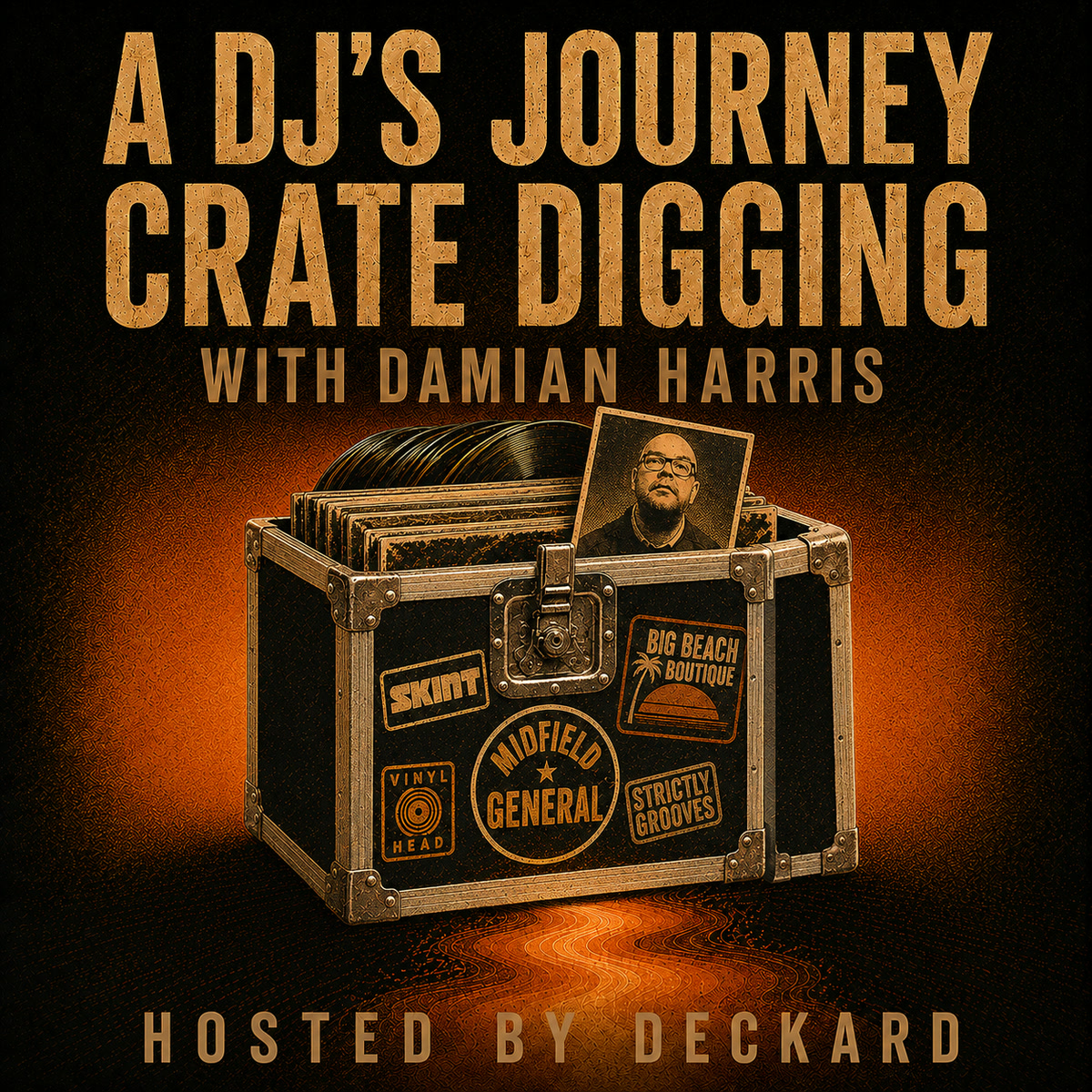
Damian Harris is a record label founder, DJ, producer (as Midfield General), and A&R who co-founded Skint Records in Brighton in 1993 and built it into the home of Fatboy Slim. In this Crate Digging segment he walks track by track through his own productions and the records he signed. For the full label-boss story, hear Episode 18.
Subscribe to The Crate Letter at adjsjourney.beehiiv.com.
Damian Harris gives the full label-boss story in Episode 18 — founding Skint, A&R'ing Fatboy Slim, and the Big Beat Boutique. This Crate Digging segment is the track-by-track companion.
Norman Cook / Fatboy Slim appears in Episode 17 — the artist Damian signed and named. Same story, opposite sides of the desk.
Krafty Kuts appears in Episode 11 — another angle on the Big Beat Boutique and the mid-90s breakbeat scene.
Short-form highlights from Damian Harris's Crate Digging session. Find the episode through YouTube, then land here for the full conversation, transcript, and links.
Introduction
Midfield General — Devil in Sports Casual (1997)
Midfield General, Devil and Sports Casual, 1997.
yes. So that track is all based around the speech. that was given to me by hard knocks, who were also on skint. We, in the early days, we were being, we were being wooed, quite heavily by quite a lot of major labels.
amazing sort of wooing trip. yeah, so in those early days, you're always after anything that says your name or, know, Norman used to do it as well, Cold Cut. If you've found an audio source that either had your name in it or something cool, you would use it. so, so yeah, I mean, the track pretty much wrote itself after that.
Mid-Fielding ft. Noel Fielding — Generalization (2000)
Mid-Fielding featuring one of my favorite comedians, Noel Fielding. Generalization 2000.
yeah. So, kind of relating to what I was just talking about, you're always looking for a vocal source, because we, we didn't have, or we didn't know many MCs in the UK at the time. so you're always looking for a vocal source. I, I always liked the idea of telling a story and a track, having,
you
mutually beneficial. Yeah. Awesome.
Ooh. So I had always wanted to do a track. I'd had this track for quite a while and it was called Rave Acne. And my good friend Kid Acne, who was an MC from Sheffield. And I'd been remixing a track of his and I just always liked that idea of mixing sort of rave sounds with hip hop.
And, I had really liked, I got a demo from the bumblebees who are from Australia, Australia. And that's how I got to hear via his voice. And I got in touch with her. I, had been speaking to them about possibly signing the bumblebees. but it never happened, but yeah, she recorded the track for me. She did a load of, she did some stuff.
Midfield General — Disco Sirens (2008)
the disco sirens.
people on that.
So follow up question, you said difficult. For what reason? Or reasons.
Yes.
You
to have a sabbatical slash work on my difficult second album. Looking back, I should have just been releasing stuff constantly, but I had in my head that it had to be an album. I just lots of overthinking, a bit confused. I was heavily influenced by being in Paris with the Ed Bangalot.
Confused.
Justice — D.A.N.C.E. (exec-produced, 2007)
I'm going to jump ahead then one. You executive produced D-A-N-C-E in 2007 by Justice.
Yes. Yes. basically what I did was I arranged the choir. So we were hanging around a lot at that time. and they said, we've got this track we'd like to get a sort of an English school choir, a bit like sort of, you know, another brick in the wall or something like that.
You
Finding the choir doesn't really, not quite as glamorous, it?
Side question or follow up question. Were you, so were you hanging out with those guys kind of like before their big skyrocket to fame as well then?
Yep.
Yeah. Yeah. So I, um, so what happened was, in 2004, we signed a record called theme from vicarious bliss. And, uh, I think it was Ed Banger's maybe third or fourth record. Um, I'd met Pedro before, um, and there was the justice remix of it, which was just phenomenal. I absolutely loved it. Uh, it was a great track.
Mm-hmm.
everyone's at all the parties. All those early skint parties, all of us were playing because we were all there. It was the same for the early Edbanger parties. Then once you get success a couple of years later, it's like, well, they're in Berlin that night and Norman's playing in Stockholm.
That's phenomenal that you were there for the very beginning of Big Beat and right there with those guys for this electro revival.
Mmm.
Yeah, yeah, no, I, it was weird. kind of, so lots of it's like, I used to go to trash a lot with Errol Alcon and yeah, so a lot of that I used to sort of just, I went through my more money than sense stage and aside from giving it to my brothers to start a restaurant, which is the sensible thing to do.
Midfield General — Reach Out ft. Linda Lewis (2000)
well, it sounds like, I mean, you're, you're in two important parts of history. So, you know, if nothing else, you've got stories for days. okay. This next one, I, a personal favorite of mine, a song that I have played at the end of my sets too many times to count reach out featuring Linda Lewis 2000. And, and just without sounding like I'm overly complimenting you. One of my favorite ballads, one of my favorite tracks of all time.
Yeah. Yes, yes.
right.
thank you. Well, likewise. Yes. So. My first year at college, I am living in a shared student house with three girls who are on fashion, who are all in the fourth year, who are working so hard, never go out. And so I thought I was.
Yeah, I didn't want to sort of insult the memory of this amazing record. And so it took a long time and it wasn't until that bass line, I kind of got that, that bass line, which happened one stoned evening, that I suddenly went, I think we might've cracked it.
you
Uh, she was an absolute joy. Um, so yes, I was really, really pleased with that. And, um, yeah, I'm going to have it played at my funeral and I want everyone to cry because it still makes, it still gets me as well. So, uh, yeah, I.
yeah, it does. does. Yeah. It hits that crescendo and it's just like, wait, like what a way to end a party or just, you know, it's just joyous. It's so joyous. So a personal thank you for that track. And that's a great story.
Yeah.
yeah. Yeah.
Opened with it. Okay.
So segue.
Yep.
Yeah.
Alright, okay.
is credited as being mixed by yourself and Fatboy. So whatever you can tell me about, not necessarily the whole event, and we can get into that in the longer interview, but about the album itself.
Yeah.
Yeah, yeah, that's a long... Well, I mean, I...
first handful of the sort of slower things so I got reach out on there. Do you know what I can't actually remember what other tracks are on there down as me. Do you have it to hand?
And just give me one second here.
I'll have a look on...
I just looked it up, so I just had it up on the page.
Yeah, because when you're doing that,
So we've got, the track list, at least on Discogs is Reach Out and then it goes, yeah, Reach Out, Talking About My Baby, your Disco Reshuffle remix, Super Styling, Dan Mass Hayes, Lo-Fi All-Stars, Tied to the Mast, and then maybe, I don't know if this is where it gets into Fatboy, it just won't do.
yes, yes, my-
yep, yep.
And then Curtis Mantronic, yeah.
Yeah, that's where it goes to him. So yeah, so it was interesting. There's always sort of, not political, but because we didn't just use the recording of the day, it was, yeah, what do you sort of want to put on? Quite a few of them are skint records.
Right.
Yeah, because that Dan Mass Haze was a track I loved at the time. That was Dan Carey, who is the sort of superstar producer now. Yeah, so it was sort of trying to get into sort of 15. So what's that? Probably 15, 20 minutes. Yeah, you're always looking to go, right, OK, how can I?
Lo-Fidelity Allstars — How to Operate with a Blown Mind (1998)
I kind of looked at the album and the video that ended up resulting as kind of a director's cut of sorts. For whatever actually happened that day, here's what we can put out on a product. OK, a couple other ones. And these are from the label. Low Fidelity All Stars, How to Operate with a Blown Mind, 1998.
Yes, right.
Yeah. Yeah.
Oh, well, ironically, I went to see them two weeks ago. They played Phil, who is sort of like the lead of the band. He's the only original member. Actually, do you know what? I'm going to start again.
You
you don't need to know that they weren't that great. Okay, so how to operate with a blown mind. I have been re-listening to that recently. I played Vision Incision on my radio show this week. I have such great memories of that album. People always ask what are sort of amazing skint moments and
You
And they could have gone on, you know, they, it's, yeah, it's, still upsets me slightly that they never quite realized their full potential. but for two years, they were my favorite band in the world. And, from the moment I saw them, in a place called the Dublin castle, I just kind of knew I had to sign them and I knew we had to work together. So it was a, it was a sort of one of those.
Bentley Rhythm Ace — self-titled (1997)
brilliant. Last one, Bentley Rhythm Ace, self-titled 1997.
Yeah,
We went to, they were recording the album and we were spending quite a lot of money. They were recording it in UB 40s studio in Birmingham. And for us, we were putting quite a lot of money in and they were taking their time. And it was like, come on, we would like to get it out. And so we went up to Birmingham and me and my partner and.
Space Raiders — Don't Be Daft (1999)
You, you brought them up. I, I did, I forgot that they're on skint. So I have to bring them up space Raiders. Um, in particular, my, my best friend, he was my DJ mentor and he, he was. Before I picked up vinyl, he was coming, you know, he was coming in with these vinyl and he was aside from like say fat boy and some of the records that were coming across. He was the first one for me that introduced me to big Beat.
Right, okay.
And so he puts on this mix and I hear, I need the disco doctor. And I can't remember if it was glam raid. And I'm just like, I'm hearing these songs going, is this? It's like, it's a little disco. It fits in with big beat. What can you tell me about the Space Raiders? Don't be daft or those albums.
Glam Raiders, yeah.
Hahaha
Okay. Yeah.
and very strong sort of pickled onion flavor. And so they sent a packet of the crisps, they sent a box of the packet of the crisps with their tape in it. And again, lots of stickers on it, all very well decorated and things like that. And again, the same thing, God, as I tucked into the...
As is the song.
I remember someone who was a good friend, Justin Robertson, reviewed it in Jockey Slut and said, this is awful. What are you doing, Damian? And I remember just, and I was sort of quite upset going, have we pushed it too far? And, but I still hear that record and just think.
You've got something.
I remember doing that, there was a hip hop band had sent us a sort of pastiche of straight out of Compton called Straight Out My Rectum.
what we had was just sort of creative, interesting, talented people with their first 10 records going, listen to this. Would it be funny if we put that over that? And would it be interesting if we filtered that up? And yeah. So, and I think that was a lot of that time, that sort of instance of creativity.
Yeah.
Yeah.
Yeah.
Yeah, yeah, no, no, absolutely.
Thank you so much.
Pleasure, absolute pleasure.