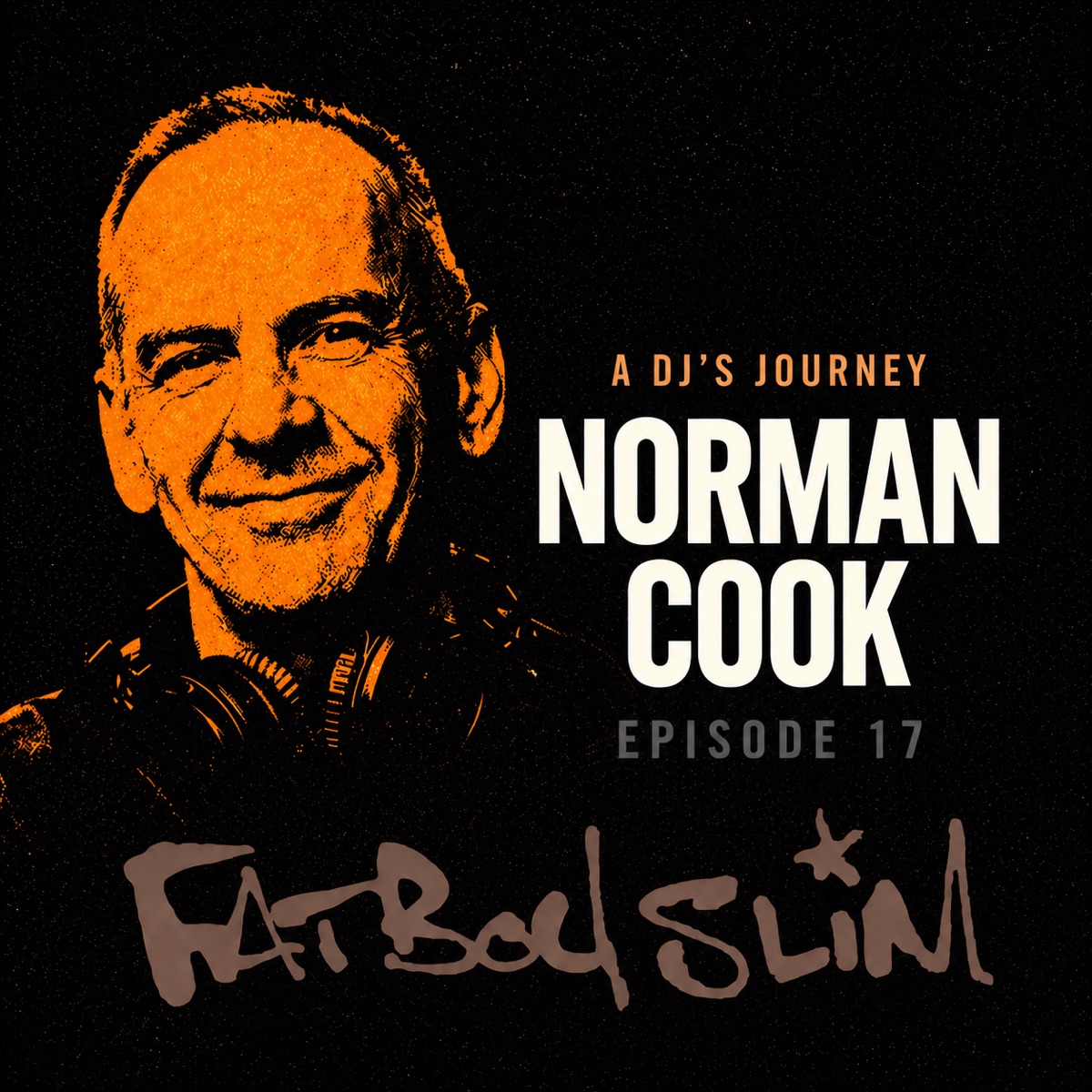
- 01How punk rock at 14, The Housemartins, and studio curiosity pushed Norman Cook toward producing records instead of just playing them
- 02The four-part blueprint for Big Beat: Beatles pop hooks, punk independent spirit, hip hop break beats, and acid house energy
- 03Why Brighton's Tuesday-night Big Beat Boutique became the club that named an entire genre
- 04The Krafty Kuts dubplate story, confirmed from behind the Southern Fried counter, and how Norman thinks about A&R as sharing music with friends
- 05How the 360 DJ-in-the-round at Brixton Academy was invented out of fear, staging, and a desire to project to the back of a rock venue
- 06Why Norman still feels connected to music in his darkest hours and how NHS-funded DJ workshops became part of his life today
- 07The story of Damien Harris talking his way into Skint and A&R-ing Norman into becoming Fatboy Slim in the first place
Norman Cook is a DJ, producer, songwriter, and bridge figure whose career stretches from The Housemartins to Beats International, Pizzaman, Mighty Dub Kats, and ultimately Fatboy Slim. He helped define the public face of Big Beat while pulling together punk energy, pop instincts, hip hop breaks, acid-house momentum, and clubland humor into records that crossed scenes and continents.
Beyond the records, Norman's story runs through Brighton's Big Beat Boutique, the rise of Skint and Southern Fried, the reinvention of what a DJ performance could look like in a rock-sized room, and a present-day practice that still includes over a hundred shows a year alongside community-facing DJ workshops. He remains one of the clearest through-lines between underground club culture and mainstream dance-music visibility.
Krafty Kuts appears in Episode 11, where Martin Reeves tells the dubplate story that Norman confirms here from the Southern Fried side.
The Freestylers appear in Episode 14, which frames the UK breakbeat and Fresh Records side of the same era.
Plump DJs appear in Episode 15, where Lee Rous recounts the naming story that Norman validates here in real time.
Justin Rushmore appears in Episode 16, giving the Finger Lickin' / Soul of Man side of the Brighton and Big Beat ecosystem. This episode picks that thread up and pushes it to the center.
Damien Harris, whose story closes this episode, is the next stop in the arc. This page sets the table for that follow-up conversation even before Episode 18 lands.
The Early Musical Influences of Norman Cook
All right, we are here. My name is Deckard. This is a DJ's journey and I am thrilled to have the one man who half of my guests have mentioned in their podcasts, Norman Cook, AKA Fatboy Slim. Welcome.
I'm like the devil, if you mention my name three times I will appear.
It's not even three times, it's one time and you appear. ⁓ Well, thank you for being on the pod. Much appreciated and especially on short notice. And ⁓ we will get right into it. ⁓ Norman, what was music like for you growing up as a kid?
Music when I was a kid, it was full of wonder, ⁓ but not helped by my parents who had terrible taste in music. So, but that was kind of all right because the fun of music was about rebellion and about trying to find noises and things that your parents didn't understand or like. ⁓ So we agreed on the Beatles and possibly the Carpenters, but the, yeah, my musical... journey with my parents ended there. And I was just looking for something different. I was always turned on by pop music and what it did to you and how it made you feel from a very early age. And that's all I ever wanted to do. So I just devoured pop music through the, I was born in 63. So I started coming of age around the early seventies and I just devoured everything. And then properly came of age punk rock. came out in 1977 when I was 14. And that was the first time I was like, right, I want to do this. And punk rock also allowed you to do that. It had that kind of independent spirit of like, you don't have to have been to music college. Here's a guitar, here's three chords, now form a band. And I did. At 14, Originally on drums, and then I was on vocals, and then I was on guitar.
14.
It was kind of you. didn't really know how to play any of them, but it was like it didn't really matter in those days. So that's and that's when I thought to myself, you know, I really, really enjoy this. want to make a living out of it.
that age. That's ⁓ so rare for anybody at that age.
Yeah, from age eight, I used to tell everybody I want to be a pop musician. Well, I used to say I want to be a pop star. But then after punk rock, I didn't want to be a pop star. I wanted to be a musician.
musician. that's interesting. So how did you go from, I don't really know what I'm doing, just, know, Dave and Dave Groll's talked about this, just, you know, just get on the drums and play loud, just play. How did you go that road from I'm just playing to now I want to actually learn what I'm doing, learn the craft?
Adieu! ⁓ well, the thing is, I never really learned a craft as a musician. ⁓ I like I said, I switched around instruments, but the first professional band I was in, I played bass, ⁓ which is all right, because it's kind of it's there's less strings than there are guitar and, and you could be a competent bass player, as long as you've got the kind of you can lock down that rhythm section. Doesn't really matter if you can't play a huge amount of notes at one time. ⁓ But then as soon as that band went into the studio, I realized I was way more interested in production side of it than I was being a, you know, a talented bass player. I said, as soon as we went in the studio in a proper professional studio, I would just sit next to the engineer and go, what's that button for? Why are you doing that? What's reverb? What's compression? And so I sort of gravitated into being a producer who is a jack of all trades and a master of none. So I'm a very average bass player. I'm a very average guitarist. I can play keyboards really averagely, but put them all together, especially if you're using computers as well. And you can make records, make decent records without being a ⁓ gifted musician.
Transitioning from Musician to Producer
Was there a part of you that as a bass player, not known for being the most outward or the front of the band, was there a part of you that was maybe wanting to be more of a lead?
No, I was quite happy. thought I was the bass player is always the most well rounded member of every band. There is the most dependable. They kind of they're the conduit between the drummer who's like the Neanderthal side of the band to the egos that go on out front with the lead guitarist and the singer. So you're kind of what you're sort of you're the linchpin between. No, I never I and I suppose that's probably why I ended up being a DJ because DJs have in those days were never the center of attention. We were just the people who provided the music and kept the rhythm going. So I'm more interested in just keeping the rhythm going rather than showing off and being the center of attention.
The Birth of Beats International
And so when you went from, your idea as a producer ⁓ comes into play here. So you go from Hal Spartans. ⁓ I discovered you with Beats International. I remember seeing some clip on MTV and talking about, you know, Norman Coke and Beats International and taking this, ⁓ you know, Clash bass line and putting it together into this kind of beautiful vocal. ⁓ So I'm curious, number one, what was that like for you going into Dove Be Good to Me and having immediate success on a new venture after Hal Smartens?
For me it was lovely because I always really liked dance music. ⁓ But in those days dance music was actually called black music, or in England we just called it black music, soul music. ⁓ being a suburban English white guy, I didn't feel like it was my place. So the House Martins was kind of what I figured was my destiny musically. ⁓ But I always like this, I always like hip hop and soul music and gospel and blues. But the only way that for until then, the only way that for a white guy to do it is to put on an American accent and sort of, you know, pretend to be black and pretend to be American, which a lot of English people used to do. But I wasn't comfortable with that. But when they invented the drum machine and the sampler, or rather when the drum machine and the sampler became affordable, then I'm like, well, can make a rhythm section out of old break beats from old black records. And it allowed white English people to make dance music without having to pretend to be American and black. And that was tremendously freeing for me. I the House of Milders, I really enjoyed the time playing bass, but it wasn't my band, it wasn't my songs. Paul Heaton, Paul and Stan wrote these beautiful songs and it was... It was a pleasure to play them, but it wasn't really my style of music. And then around that time, people that I used to DJ with like Cold Cut and Tim Simenon with Bomb the Bass, they were the people I used to DJ with and now they were making records and getting the charts. And that was kind of why I had to leave the house martins because it's like, actually, this is the music I really like. And now I've got a chance to make it. And so I used the money from the house martins to buy myself a, you know, a sampler and a drum machine and a four-track Porta Studio and start making the music that I loved rather than the music I felt I ought to play.
And did you go from, going from, ⁓ did two albums with Beats International, I asked Beats International, but also doing Mighty Dubkatz and Pizzaman. ⁓ Were those just different outlets for you to kind of go different directions on genre or what were you looking for in your personas there?
Exploring Different Musical Personas
Well, in those days, genres were quite rigid. It was like, if you did one thing, then you know, you couldn't do another. So it was like, especially when I was in the house minds, it's like you're a white indie band. And then I put out a record that was a cut up like hip hop record. And everyone was like, you can't do that. It's like, you know, you're either, know, pick your side. And there was kind of, yeah, it was, I've always had, I've been quite eclectic in styles of music. And so I started, yeah, by this point Beats International had split up and we'd morphed into Freak Power, ⁓ which, but that was still very much a band, a traditional band. But I just, at home, I'm just made of these crazy tracks and put them out under false names. And so sort of Pizza Man was my kind of house alter ego. Freak Power's like kind of acid jazz and funk. Mighty Dubcats was just anything that nobody else would touch. So they were like, this is too weird or stupid. So I would just put it out on my own. Yeah, yeah. Everyone was like, what is that? Is that a house record? And so the stuff that loaded records refused as pizza man records because it was too stupid. Me and my manager decided to just put out on our own label. So we invented Southern Fried.
Magic, magic, magic carpet ride.
which is just an outlet for my more eclectic stuff that other people didn't like. ⁓ But also, I mean, in those days, pre-internet, you could have different personas going and no one really knew who you were. You were just selling 12-inch singles off the back of a van and no one really cared who it was behind it. So I could have... So yeah, I mean, at the time when I started to be Fatboy Slim, I was in Freak Power. I was signed to Island Records as Freak Power. I was putting out Pizza Man Records on Loaded. and Mighty Dub Cat's records on Southern Fried. ⁓ Just so that it was a kind of outlet for my output.
Sounds like a great side hustle also, having multiple names and releasing at the same time and people not knowing necessarily.
Yeah, I I didn't I sort of reveled in the anonymity of it all. But even then, even in those days, it was like you didn't want people to know you were white. You know, if you're putting out house records, you just maintained people's, know, ⁓ you know, maintain the suspend their disbelief that you're whether you're white or black.
Yeah. So do you ⁓ you might subscribe to my theory here? It sounds very similar because I grew up listening to eight tracks in the car and it was ⁓ You touched on the Carpenters. I remember that one and ⁓ Kenny Rogers and Neil Diamond and you know There was there was some some some greats for sure But not necessarily what you would think of as a kid growing up, but it feels to me like there's there's this whole generation You would be part of it ⁓ where we grew up with kind of whatever our parents taste in music was and then as we got to adult age and making music there there is like you said there's all these white guys that are really paying homage to the music though like there's a real love to it it's not it's not novelty ⁓ it's a real like this was part of our roots
The Evolution of Big Beat Music
And your question is?
Well, just, I mean, do you feel that across? feel, you know, for me, for some reason, I don't, you know, as far as breaks go, especially, ⁓ it seems to be very centered in the UK. ⁓ There's definitely, you know, Canada and Australia, there's a similar kind of ⁓ vibe to it as well. But ⁓ yeah, I don't know. I guess I'm just curious if you think that also applied, you know, to the rest of the UK scene as well.
Well, me, what it was, like I said, I've always been fairly eclectic and rather than having like an output for the different kinds of music, for me, the big beat, as we called it, or break beat, was basically you could have your whole, all the influences in your whole life in one record. So basically what we had was the pop hooks of the Beatles that I grew up with. mixed with the attitude and the DIY spirit of punk rock, then mixed with the breakbeats of hip hop and funk that I'd always loved, with the energy of Acid House, which had been the previous kind of musical revolution before it. So basically, just put those four, we've just put those four ⁓ ingredients together and said, well, why not have all four of them in one record? You have like catchy hooks, ⁓ punk independent spirit, break beats and acid house energy. And that was kind of the, that was the Fatboy Slim blueprint.
And did that tie in with, was it the Zap Club?
No, no, the Zap Club was playing just house. were that was like, house. Yeah. So we
house. So was that coming into so so so Big Beat Big Beat Boutique is that kind getting into the era then that you're you're talking about with the records you're making?
No, what happened was there was a of ⁓ a funk and soul club called Shake Your Wig that I used to play at, but I was doing quite a lot of drugs. so I was kind of trying to inject acid into the kind of trip hop and funk thing. And the sets I was playing with were kind of the mutating into this other thing. And then a friend of mine, in fact, it was Lindy who had sung on on Dubby Good To Me. She said, you know that set you play, which is kind of like sped up break beats and bit of acid and you know, says there's these people in London called the Chemical Brothers who are doing it. And so she took me to the Heavenly Social to see the Chemical Brothers. And it was just like meeting your long lost family that you didn't know about. then we realized there was other people playing it. So I started going up to the Hemley Social every week, but I live in Brighton and that's in London. So it was quite a trek. So we decided to open our own club in Brighton and we called it the Big Beat Boutique. And that was where the term Big Beat came from, which I was very, very honored by. Cause if you think that, you know, garage music comes from the Paradise Garage, house music came from the Warehouse Club in Chicago, but Big Beat was named after our little club in Brighton. But no, the ZAP Club wouldn't touch us because they thought we were lunatics and we were breaking all the musical rules and we would play anything from, you know, the Beatles to... And we were playing trip hop records at 45 and playing techno records at 33. And it was just this weird mulching and coming together and West Coast break beat records. So they were really big influence on us. And... But it was just like, was a very English melting pot of different things. no, at first, yeah, the only, you know, we had our own little club because no one else would let us play that mix of music in their clubs.
The Rise of Big Beat Boutique
What was that run like? Because for me, by the time that I did get that sound over, and it was probably around 98, 99, somewhere around there, for sure 98. But when I got your Big Beat Boutique Mix CD. I I listened to that and like it was the Zapruder film, you know, like I've tried to try to break it down in my head as far as just what you were doing, you know, what this what this mix of music was, you know, the other side of my music love was more like the Sasha Digby kind of style. So there's very, very different, you know, like in. ones doing these long blend mixes and way more atmosphere and, you know, progressive sound at the time. And yours is, you know, I don't know if in your face is the right word, but just, you know, the beats and everything, you're mashing up things and the energy is just there. ⁓ So I'm curious what those was, how did that, that night at Big Beat Partique progress along through those nineties?
Well, it was like I said, it was sort of like, it was our clubhouse in Brighton. And so it was, there was a lot of cross fertilization. We, there were, you know, we would get the chemical brothers to come down from London. We'd get DJs to come down from London. And then it was like a, but it was like a breeding ground of something, you know, a new take on, on, like I said, you know, a hybrid of all these different styles. And it was was yeah, throwing them all together and keeping the energy going, rather than being too sort of shoe gazing around here. was like it was quite ⁓ immediate. But it had it had a real energy and from the word go, you know, we got we did it on a Tuesday night and primal scream turned up and then they thought it was quite funny. And then from that we got a Friday night and then we got a residency. And then quite quickly. the queues started getting longer every week and we kind of knew we were onto something. And it was like every week where it's like more and more people come and go, no, we've heard about this new sound you've got. And it was quite accessible. mean, there was one thing about it was it was accessible to rock fans because it wasn't too ponderous and too holier than now techno. It was kind of accessible for rock fans and everybody could have a bit of a cavort without worrying or thinking too much. And then as the records started to take off, the cues got bigger. But it was very much our clubhouse. was like the resident DJs were all the Skint Records staff. And ⁓ then we would just hear about other people. But again, cross-polarization, we would have Aphrodite come down and play, sort of jump up, and then Carl Cox would come and play. But it was like, well, you can play, but you can play slightly outside your genre. And they used to love coming down. We had everyone from like the big audio dynamite sound system to yeah, to Carl Cox. And there was a kind of anything goes, let's forget musical genres. Let's forget the barriers that said, you can't put that with that. And let's, you know, mash everything into a melting pot.
And where was that time time wise? What like what year we had here? I saw you. I ask you because I saw you play in Seattle in 99. So is this kind of the lead up to those that year?
Weird. Yeah, no, this started in like 96. I mean, was still, the first few boutiques, was still, one of them I was actually billed as Norman Cook and then as Fatboy Slim. It's twice on the same bill. So it was, yeah, I mean, the first, I think about 96 was when it started. like I said, yeah, just built and built. then we start, you know, but obviously, in those in those days, there wasn't a huge amount of unless you had a record out, it was only when the record started taking off that people outside Brighton kind of clocked on to or outside London clocked on to what we were doing. And then, yeah, it just sort of grew and grew. But from 96 on
And was there a particular moment that you felt like US at that in the nineties was particularly difficult for a lot of electronic artists and DJs. You know, from Prodigy and Chemical Brothers and Underworld, you know, maybe would do shows and, get some attention from that perspective, but it just, it really wasn't nearly the same as it was now. So I'm curious, what was your first kind of knock on the door of America? ⁓ You went on to do Red Rocks and some pretty famous gigs, but what was your kind of first intro?
Breaking into the American Market
First I played a strip club in New York, the first time played in America I played a strip club in New York called Don Hills, ⁓ which bizarrely was James Murphy. James Murphy years and years later sent me a photo that he took of him shaking hands with me in the DJ booth and he said, you kind of changed my attitude to music that night. ⁓ But I don't know, I was standing on the...
Really good.
the shoulders of giants because like you said, the prodigy had already made some inroads and Tom and Ed had been over to America before me. But I mean, I think the thing I loved the most was realizing that there was another wing of the family in America. you know, went to, I played Spunda in San Francisco and it's like, yeah, you lot are as stupid as we are. And then I met the Crystal Method and
Yeah.
you know, they were definitely as stupid as we were. yeah, and it was funny, it was like connecting the dots of this kind of before this is before the internet. So there was no way of really sharing those ideas apart from you'd remember names from from from records you bought. And there was like the bass bin twin. ⁓ And I mean, the crystal method definitely they I played a show a few shows opening for them and they kind of took me under their wing and they're like, yeah, you're one of us. And they, and it just grew and grew. no, mean, I was, there was, were people who'd been over, like the Prodigy and the Chemical Brothers had definitely opened a few doors by the time I got there. So I felt there was an excitement. but it was very different. Like when we went and played, there was still the kind of big baggy-trousered candy ravers going to the West Coast Jam from when were doing them. And then in New York, was more, yeah, it was much cooler in New York. It was weird. I mean, for me, it was the first time I'd ever done anything in America. All my previous bands, we'd never even attempted to break America. And for me, it was great. And as a music fan, to be traveling around all these legendary places and, know, and it was, yeah, it was a real eye for me. But it was, I think. By the time I came out, we were just getting into the second album and then everything just started exploding. the Praise You video and the Rockefeller skank video kind of opened so many doors. then everyone was like, it's this British explosion. What is this music? They were still calling us electronica. I was still in the electronica section in the record shop. But they were sort of talking about this wave of the British invasion.
Right, yeah, yeah, electronica, yeah.
For me, it was exactly the same as the Beatles listened to soul records. Then they did their take and they brought this white version of soul music, sold it back to America. And they said, what is this music? It's like, it's your music, it's your indigenous music that we were fans of. And we've done a white English version of it. And you like this more than the originals who, you know, are right under your noses. We were the same thing. It was like, you know, we were trying to talk to people about... you know, about the sort of the great, you know, the techno artists and the breakbeat artists that influence us. And everybody's like, where are these people? It's like, they're Frankie Knuckles and they've been right under your noses, but you didn't value them. It took us to whiten it up and make it a bit more commercial to sell it back to you. So I felt part of a rich tradition of white English people selling black American music.
You Right?
And also there was the gay thing, because house music had come out of ⁓ black gay America, which is a bit unpalatable to middle America. especially Rockefeller skank got that kind of, what was it someone called me, frat boy slim at one point. Because it was like the dumber end of America get what I was doing, but they couldn't get what.
So ⁓ I
They couldn't get what Josh Wink was doing, but because I kind of put some pop hooks in it, it's like, we get this now.
Right, well, and you had the Satisfaction skank, ⁓ which after 25 years finally got a proper release. ⁓ So I'm to time hop a little bit, but I'm curious about that because I think what you said makes sense. I remember your records were already popping and then mashups and remixes like this, kind of the white label remixes for, I think, for a lot of people and even as a soon to be budding DJ.
The Journey of Mashups and Remixes
Yeah.
Those were rare. These were very hard to come by. It was difficult to get on the internet. So I'm curious, after 25 years, how did you finally go about getting that properly licensed and what took 25 years?
What took 25 years was the Rolling Stones management. When I made that mashup just for me to have something in to play my sets that no one else had, I was getting a bit bored of playing Rockefeller Skank in its original form. So I made it, I had one acetate of that and I played it a times on the radio and people go, we want to buy this record. So we went to the Rolling Stones management and said, can we release this? It's called a mashup. It's like, and they just went no. And then, And then it got bootlegged. Because I'd played it on the radio, someone had a good copy of it off the radio, so it got bootlegged. And then we went back to Rolling Stones and said, look, this tune is getting bootlegged. This is how much people want it. Can we please release it? And they said no. And then years later, the Rolling Stones asked me to remix Sympathy for the Devil. And while I was doing that, I said, we could put that other mashup of mine on the B side. And they went, no. And so we just got Stonewall and we gave up. We gave it, you we just thought, well, it's just one of those things that will never be. And then 25 years later, the Rolling Stones came back to us and said, do you fancy putting that out? And we're like, yeah. And I don't, I don't know what, I don't know what changed. I don't know what changed. Maybe, you know, they just, I mean, for me, the loveliest thing is that it still kind of works because most records 20 years, I mean, I kind of, mixed it again because I'd originally just done it as a sort of throwaway. So I did re remix it, but It still works as an idea. because it was never released, you know, because it's the only people who had it. You tell us about you came out. Yeah, I had a really scratchy copy of that, you know, from back in the day. But I'm glad it still works. And I'm glad we finally got it out officially that everyone can hear it. And but I you'd have to ask the Rolling Stones management why it took them that long.
Yeah. Yeah. Why are they feeling got to? So I'll jump back again to that tour and that height of Big Beat. So I was struck at that show. I saw you at the Paramount in Seattle and Summer of 99. And I think you might have been one of the first, not the only, but to do it in the 360. You're DJing in the round like that. What was your, did you get that from somebody else? Did you see other people doing that? you know, because it was a real, I don't know, it was a real different experience, you know, going to a show like that.
Innovating the DJ Experience
No, it came out of It came out of fear because I got to a point where we were playing larger and larger venues. I don't, know, for me, DJing was something you do in nightclubs. And we were starting to play much bigger venues. And it's like, Christ, you know, you play a big room like that. It's like, how do I project to the other end of it? And how do I make this feel? This looks like a rock gig. but without much production and without much, you know, I can't run from one end of the stage to the other doing guitar solos and entertaining like that. So it was just a way of breaking the room up and making it feel more like a party. If you go in and you haven't got the stage at one end and you know, and you at the other. it just, yeah, and we did it, the first time we did it was we played the Brixton Academy, which in those days seemed like the biggest venue a DJ had ever played. How do we do a show in a rock venue, steeped in tradition, that holds three and a half thousand people? You know, it's like, how do we do it? And I was doing it as ⁓ a ⁓ back-to-back, ⁓ tongue-in-cheek. Well, I was doing a back-to-back with Armand van Helden, which was supposed to be the boutique's third birthday party. Only the, like, in the run-up to it, I just had my first number one.
Yeah.
Armanda just had a number one in England and it's like our little venue just couldn't cope with that. So we moved it to the Brixton Academy, ⁓ which is the biggest venue we'd ever played. we just thought we were like, how do we do it? And we were billing it as a boxing match. So what started out as like, how do the posters look? It's like, well, do it like a boxing match. We'll have to do it like a boxing poster. And it'd be us going deck to deck, back to back, you know, at it. And then It just snowballed into like, well, we could build a boxing ring in the venue. so yeah, was the first time we did it, we did it as a joke because it was a fake boxing match, but it was the only way that we felt we could fill a venue that big. it was different. It was striking and it suited my style of DJing, which is to try and get involved with the audience rather than being on a... pedestal, you know, miles away. I like to be feel like I'm in the crowd. I get excited in the crowd. And so, yeah, so that, and it was difficult to do in America, in England, but in America, we would say to, know, can you build this? they go, hell, we can build anything. And we based it on the, I think there were those things that they have in car showrooms, the turntables. They said, yeah, we can get that out of a car showroom and we'll just put that and make it the stage.
So yeah.
So it was, yeah, I mean, a lot of my show was based on the fact that I was playing places where normally a rock band would be and feeling outgunned. Because it happened, though, I did a big festival in Scotland where I had to follow the Foo Fighters. Now, they'd just been, you know, doing drum solos and guitar solos, running around, really rocking people. And then I stood there a little bit nervous while they took all their back line off and then they just put a table. about 30 yards away on the front of the stage and put two record players on it and a mixer. And I was thinking, how do I compete? You know, it's like, I'm going to have to up my game. So from then on, it was like anything goes, which elevates this from a middle aged guy with two record players playing new records. Any way we could make it a show, we would. And nowadays we've got the technology and you know, LED and stuff like that. We can do that. But in those days, we were just looking for anything that meant I could
you
play a really big crowd and entertain them without them just going, it's a bloke playing records. Because that was some of my first trips to North America. A lot of people, they'd heard Rockefeller Skank and they'd heard Praise You and they thought I was the warm up DJ before the band Fatboy Slim came on. And it was like, again, pre internet, nobody knew what to expect. And they were like, so this is it. You're just going to play records at our site. And it's like, yeah.
Yeah.
The Impact of Live Performances
But I'm going to try and make it as entertaining as possible. So did you enjoy that show in Seattle then?
Well, maybe they saw a soul. ⁓ okay, well you just asked the right question. ⁓
They were quite wild in those days. The good thing was that the people who turned up there tend to be the people who get it. And it's like, fuck yeah, we're going to have a laugh.
So the reason you're here today on a DJ podcast with me is because 29 year old Keith at that time was looking for something bigger in his life. And I had just met this new group of friends and Mitch Bate who went on to become my DJ mentor. He kind of, he took me down this road of going into clubs in Seattle and he was, you he was a really good DJ and, I had never done ecstasy before. so on the, on the day of fat boy slim in Seattle, I'm going with my new group of friends. go down there and I can still remember being in the round and we were probably about five rows back or something, you know, rows, but five people back. And I remember him just looking at me as we take it and he just goes, he goes, look around right now, goes, in an hour, this place is gonna completely transform. It's not gonna look anything like this. And I'm just kind of like, okay, okay. It blew me away in such a way that I can still remember what it looked and felt like and smelled like in that room that night. And I was married at the time, my wife didn't go to that show. And afterwards, the next morning she goes, so how was it? And I just remember looking up to her and I just said, life is going to be a lot different going forward.
It's such a fabulous story. It's like we took your virginity twice in one night.
The Journey to DJing
And ⁓ I, yeah. Yeah, exactly. And five months later, on New Year's Eve, 99, I made my New Year's resolution that I was going to become a DJ. And now we're 20, 26 years into it. So thank you for putting on an amazing show and having it be everything that I would have wanted for that time. It was just a, it was an absolute mind blower.
Excellent. Excellent. Well, I'm touched. mean, that's kind of like, it's things like that that make what I do worthwhile. It's kind of, there's so many people like James Murphy said, you know, I wanted to take up DJing after seeing you. And I'm like, another soul is mine, another notch on my bedpost.
Yeah. And, it's. Yeah. And I have, I have, you know, a couple of friends like that as well, where they saw me play here in San Francisco. And it's so humbling, you know, because it's like, Oh, like this love, this passion for transmuting, transmitting music to other people. And same reason why I do this podcast. It's just, I can't get enough of this love and this passion and wanting to share, share it with other people.
and it's something I'm very, very proud of. Yeah, that's, that's, always say that there's, two sorts of people in the world. It's people who can have a favorite record and then they put their headphones and they listen to it over and over again. And they really get into every nuance of it. And then there's other people who, when they hear a really good record, all they want to do is play it to their mates. It's like, have you heard this? Have you heard this? They're, they're the people who end up as being DJs because my, my joy of in music involves sharing it with other people. It involves playing it to other people. or listening to it in a room full of other like-minded people. And yeah, that's beautiful. That's beautiful, man.
The Joy of Sharing Music
Oh, thank you. I had Martin on Martin Reese, Crafty Cuts on episode 11. And he tells the story of you walking into his record shop in Brighton and he plays a dub play dub you of Give Me the Funk. He gave it to you and what he called the best decision he's ever made in his life. And you get back to him, sign that record to Southern Fried.
yeah.
What can you tell me about that?
I just, well, like I said, Summer Fry started for me as an outlet for records that I'd made that nobody else wanted. But then it was beginning to get a bit of a reputation by, and by the time that I was doing Fatboy Slim, it was kind of, we were actually a proper record company now. But we didn't have an A &R man. So the only A &Ring was like me. So if I bumped into anyone and... can't remember if Martin was a friend by then or became a friend later. But yeah, he just gave me this, he played me. was like, he's like, would you play that? was like, hell yeah, I'd play that. It's brilliant. And after I played it a few times out, it's like, should release this. And luckily I had the outlet of Southern Fried Records to put it out. so yeah, mean, me again, you like I said, my joy in music is sharing it with other people. So when... I hear a record and it's not available to other people. I can make it available on my label to other people. That's brilliant. you know, the first 10 Southern Rite records, Southern Fried Records were all me. And then the next 10 were all my mates. We're just, know, DJs played with who played me something and I said, this should be released. And it's great. You know, it was good for me, you know, to have that freedom. the one, to no, to have the the mechanisms in place to put my friend's music out. So now I get as much joy out of it as he did.
Yeah, I remember Skanty Sandwich was a big one. Always, was that always be real? Yeah.
Yes, Skanty Savage, same thing. Same thing, he opened for me and he played because of you. And I went, what the fuck is this? This is brilliant. And he's like, I made it and you know, I said, is anyone releasing it? He's like, no, said, can I release, it out? So yeah, it was, I mean, that was probably, that was around my happiest time, I think, as an artist, that I'm just going and meeting all these new people and then being able to put out their music and. and going to other countries and meeting like-minded people who, know, and for me, that's music in its purest form, telling, you know, stories. In my head somewhere, I've got this romantic notion of a troubadour. Do you know what a troubadour was? They were basically before the internet, before telephones, before anything, they were singers who would travel from town to town.
Yeah, yeah.
singing, telling stories by singing songs because it was easier to remember the story if it was in a song. And they would go to one song, then someone would teach them a new song and then they would take that song to the next city and teach it to them. And I think there's a little bit of that in DJing and in those days, pre-internet, that was how ideas and tunes and misbehaviour, how it spread is just like it would go from one place to another and you would take a little bit of the place you'd been before with you and then add it to your repertoire.
The Troubadour Spirit in DJing
Is that, ⁓ I want to, that makes me think of the work you did with David Byrne and your disco opera. Is that part of this different musical outlets for you?
Yeah, I mean, that was that was the old adage if you're an actor and someone says, can you ride a horse? And you want the job you say yes. So I'd always loved David Byrne and I bumped into him a few times and he was aware of me and whether I liked him. So he was writing ⁓ a musical about the life of Mel DeMarcos and he wanted to set it in a a nightclub. And when he thought if Mel DeMarcos was If it was today, where would she be going? And he thought Ibiza. And what's the biggest club in Ibiza, Manumission? Who's the resident DJ at Manumission? it's that guy that I keep bumping into who really likes me, Norman. So he just rung me up and said, I'm writing a musical about the life of Maldemarcos. Do you want to do it? And I just said, yes, but I knew nothing about musicals. I knew nothing about Maldemarcos. All I knew was I wanted to work with David Bowie. And so the rest I kind of learned on the job. But yeah, I mean, I wouldn't put that in part of any grand scheme. was, I don't know where that sits in in my relationship with music. was just, you know, anyone in the world would give their right testicle to work with David Byrne. And I'm so glad I did. And the fact that it, when we were doing it, I didn't think it would ever end up. He said, I see this on Broadway. And I was like, yeah, good luck with that. But he did. He knows what he's doing. But no, to this day, he's the most beautiful and brilliant person I've ever worked with, really. And he taught me so much. ⁓ He's got just got this eclectic, quizzical, questioning, playful mind, which I think every musician should have.
Collaborating with David Byrne
What was that, I mean, the two of you together, what was that working relationship like? You seem like two, for your respective areas of music, ⁓ much revered and respected, and at the same time, you both seem creative and goofy and serious and all the things at once. So what were those sessions like?
But there were more similarities than not. He always came across as a little awkward and nervy in interviews, but he's actually much warmer and funnier than he gives off. I mean, I think we basically, after a few days of working together, we realized that we were both the kind of geeky white kids that like black music. And it just spent the whole restaurant working out how, as a geeky white kid, we can make cool dance music. You know, and and both of us. Yeah, but yeah, we were we were just like these kind of I'm not sure if this is me, but this is what I love and I want I need to find a way of me to make use these rhythms, you know, and we bonded over Brazilian rhythms. We both really like Brazilian music. And so we sort of we've got a similar mind. I mean, he the the relationship was very much sort of I was the I was the kneeling, kneeling in his lap going, please tell me more, you know, and but he was very respectful. No, mean, he said, look, this is what I want you to do. You he was writing the lyrics and the shoes. He just wanted me to do the rhythms and make it work like it was set in a nightclub.
Brilliant. ⁓ It struck me in following your career. that on one hand there seems to be this one thing after another in your career, whether it's playing in America or, I mean, jumping around here, but you know, the Olympics. You know, there's like these kind of touchstones, the Big Beach Boutique, which you're now coming up on your seventh one, I believe, this year. On one hand, you strike me as a pretty down, know, head on your shoulders kind of guy. you know, taking your career as it comes. On the other side, this your your body of work seems to also, you know, like there's some kind of drive or ambition here. And I'm just curious, was it, you know, did you ever did some of these opportunities, you know, playing the hometown soccer or football stadium? Sorry. ⁓ Do some of these events ever seem just too big or, you know, am I biting off more than I can chew? Or was this just this all naturally came up for you?
Natural Career Progression
Well, it was natural. mean, the thing you have to understand is that I have a drive and I have a certain amount of ambition, but I never had a plan. It was like, it was never like, we're to do this. We're going to take it there. would be like, I'd get a gig in this venue and it's like, how do we live up to this venue? And so there was no plan of like, I want to play this big gig on the beach. That just happened because a TV company wanted to show cricket on the beach. and they'd set up a screen and a sound system and they said, ⁓ you after everyone's watched the cricket for four days, we'll have a little party at the end. Who's the local DJ? Fatboy Slim is in Brighton. We'll ask him to do a little after party. And that sort of blossomed from there. It was never on my wish list to do the Olympics. No, basically I had no plan apart from trying to entertain people by playing my favorite records to them and waving my arms around. And then it just, these things just kind of happened. They were never, they were, I didn't have any of them on my bucket list. ⁓ And that, you know, it's just the phone rings and you go, Christ, that sounds interesting. And so I think it was my, my lack of direction allowed me to go in any direction that I was pulled.
And
There was never a plan. know, some people have like a five year plan. I want to be doing this and I want to be, you know, I want to be headlining this venue by this time. But no, just, I literally, I just followed my nose and my instincts and they led me to some interesting places.
Well, and quite brilliantly. ⁓ And I want to ask you, you've talked about, you know, your drinking in the past and mental health, and I wanted to touch on that a little bit. ⁓ And I'll frame it this way. During pandemic, you know, it was a real low for a lot of people, myself, one of them, and going through a lot of personal stuff with family and job, et cetera, et cetera. And for the first time for me, I lost my love of music, really, you or at least for DJing. just, all of a sudden I seem very disconnected from it. Can't go out, there's no clubs open, et cetera, et cetera. And... I found when I was at my low, what brought me back really was I would go in from my good pair of headphones and I would listen to the albums of my teenage years again. Beastie Boys or Run DMC, Duran Duran, Nine Inch Nails, things like that. I'm wondering when you stepped away from DJing for a bit. and got sober, I believe. ⁓ Did you have a similar experience where, you know, you felt disconnected from music? And if so, what was that like? And how did you reconnect?
Music as a Lifeline
No, I've never been disconnected from music. in my darkest hours, music is always my dearest friend. It never lets me down. It's like, it's, I use music in my job, I use music as a celebration of life and community and connection with other human beings. But in my darkest hours, I use it just to soothe that troubled mind. Or just simply, know, like when you're really down, you listen to a record by someone, you know, that's why I like the blues, I think, maybe. You listen to a record, it's like, God, I think I've got it bad. He's even worse than me, you know. I remember being really depressed after my first marriage broke up, being really, really depressed, and I listened to an Elvis Costello song called I Want You. It's like, fucking hell, you're in a darker place than I am, and you got out of it. Look at you now, you know. Two years later, you're fine again. So it can, music, that's one of the many beautiful things about music. One of the things it can do is to soothe the troubled mind. And I think if I ever got that low that I was disconnected from music, I would be in real trouble because that's always been my safety net. And like you said, during the pandemic, I was... I was the opposite. was more can I realized during the pandemic how music connects us and how much we love to that connection. there was people, you know, there's all these sort of social experiments and can we do live streams that recreate the effect of a night out or tons of my friends who would get together and they would like drink and drug together by a zoom. And it was just never quite the same. It's like as human beings, we need to be in the same room and connect. share bodily fluids and whatever. And it just made me cherish it more. And so what I did, I started doing a mix tape every week. felt I need to share my music with people. So I started doing a weekly mix tape. I would drop it every Friday at tea time. ⁓ And that kept me going. So music kept me going. It was like that was my one connection with the outside world is that the people on Instagram and Facebook could hear this week's mix and then I would just read all their comments and talk to them about tunes and that was my replacement for it and it was during that that I kind of made made a pact myself it's like if we ever get this back I'm gonna cherish every moment while I'm still young enough to do it I'm never gonna moan about an airport delay ever again you know just give me this back you know I realized I realized how much It's a part of me to share music with other people and to show off, obviously. ⁓ and, and yet, and ever since lockdown, I you know, I've up my, my shows, I'm playing every year. Like it's my last, like last year I did 122 shows in a year, which is a career high 40 years in. It's a career high, just because in five years time, I probably won't be able to do this. So I'm wringing everything out of it that I can.
Yeah. And you're also giving back. Tell me about the NHS Trust, the DJ workshops you do.
Giving Back Through Music
Well, I, they, somebody asked me to visit, ⁓ there was a ⁓ program for people, for autistic people who could get together. They were scared to go out in public, but if there was music, they could go out and they had this little club where they'd actually go to night nightclubs. And you, you think an autistic person would hate a nightclub, but they were locked in together with the music. And I thought that's quite interesting. So I went along and they said, you fancy doing a kind of workshop teaching people to DJ and then. quickly realized that music can take you away from yourself, even if it's just for half an hour. And the concentration of being on the decks and the togetherness of playing with the decks with somebody else, just something really calming and beautiful happens. And these people who, I don't even know what's wrong with them when they come in, but I just know they're awkward. And when we've had a little moment together, they're less awkward. or they can communicate again. And I never really, it's not based on any ⁓ kind of clinical knowledge I have about mental health. It's just, nice to connect with somebody over mixing music or playing with a filter and squelching and just seeing somebody just maybe have a moment off and it builds their confidence. It builds their kind of... communication with the outside world, if you're sort of shut off and locked in your own brain, music and sharing your music. And so I just started doing it. gives me, and also it reminds me how lucky I am that I get to play with the decks. know, when you see somebody else who's never played before, like, what's this button doing? It's like, makes everything go whee! And then like, whoa! And then I remember, sometimes I can get a bit jaded, but I remember how much fun DJing is, and he's just messing around with music. So it's something I really enjoy doing. now I managed to raise some money and I got Pioneer, the lovely people at Pioneer donated some equipment to us. And so now it's a regular monthly service that runs on the National Health. So it's free for anyone who wants to use music to try and soothe their mind.
Brilliant, brilliant. love it. And you, I think you, if I got the quote correctly, you said you were less interested in, you know, like making new albums, you know, maybe still some new songs, but you're just, you're, and as you've obviously shown here, you're still very enthusiastic about DJing.
The Shift from Production to DJing
Yeah, yeah. I kind of lost my passion for making records. I I don't know what happened. I I got sober, I got old and that passion that I had to share stupid noises and stupid ideas with people, it kind of went. I don't know if I... Yeah, I don't know if I, maybe I've, I mean, I made an awful lot of records for 20 years and then after 20 years, was like, maybe I've just made them all or maybe I had, I had kids, that was another thing. mean, things changed in my life and I just didn't have that burning fire in my heart to go off and go, listen to this, it's brilliant. But I, the love of playing other people's music or DJing. became stronger and the in the studio I just and after six months of sitting in the studio and nothing coming out, I just thought, well, I'll just go out, just DJ more and spend less time in the studio beating myself up because I've got a writer's block. And that was like sort of 15 years ago. So every now and then I'm not retired, but it's not my main job being a producer and being an artist. Because the thing is, it's so difficult to make good music. And unless you're absolutely 100 % passionate about it, then there's no point even trying. That's my view.
Reflections on Iconic Remixes
Right. ⁓ Norman, I want to be cognizant of our time here. I want to wrap up with just a few short questions, if that's OK. ⁓ Call it Crate Digging. ⁓ Go through some of ⁓ your past productions and remixes, and just get off the top of your head anecdote, story, thoughts. ⁓ Corner Shop, Brimful of Asha, 1997 Fatboy Slim remix.
Yeah, cool. The easiest remix I ever did and the most successful and the most striking between, you know, changing its fortunes. Yeah, just it was just a record I got sent. I thought it was a really good tune, but I wanted to play it in my DJ sets and it wasn't fast enough and it didn't have enough drums on it. And so I just said to them, can I have a make my own version? Would you give me the parts? I'll make my own version. And all I did was sped it up and put a break beat on it. and a bass line and just made it into a club record. But the original song was brilliant already and it went from nothing to number one in the charts and everyone thought I was really clever. But in fact, it was the simplest. It literally took about the whole thing took like eight hours to do because it was just for me was a simple thing. So, yeah, no, would I very think very fondly of it. and obviously it opened a lot of doors for you know that one. Having had that success with the remix, I got offered lots more, which opened a lot of doors for me.
⁓ Wild Child, Renegade Master, Fatboy Slim Old School Mix, 1998.
Well, Roger was a Roger was wild child. He was a friend of mine and he died very suddenly. ⁓ Literally just dropped dead one day, ⁓ which was heartbreaking. And when somebody talked about re-releasing Renegade Master, which had been a sort of a hit, he'd got he'd done it on top of the Pops and ⁓ they were going to remix it. And I heard one of the remixes. I'm like, Roger deserves better than this. Let me have a go at it. ⁓ yeah, the whole mix was based, the sample I put on the beginning was from another, a bitch track, another track of his. So it was my fond tribute to Roger McKenzie, ⁓ sadly after his death.
I you, 1998.
You took about life changing moments. The day I bought this ⁓ old funk bootleg compilation to hear it take your praise by Kamil Yarbrough. It was a day that changed my life. Yeah, I mean, that was the record that really kind of broke me. ⁓ And yeah, just, was just, I used to go to the local market and look at all the, and had all these kind of old funk bootlegs, you know. looking for break beat, looking for samples. And Camille sung these three lines acapella and I thought, maybe I can make something out of this. And thank you, Camille. To this day, she was so gracious. And she really loved the record as well, even though I kind of ripped it apart. But yeah, it's sort of become ⁓ an anthem for me. And I love it when I, you know, people... Once a week someone says, oh, that was our wedding dance tune or our football team comes onto that tune. The meme, the thoughts behind it mean a lot of things. You know, we've come a long, way together through the hard times. It's just a unifying, you know, feel good bond. So, yeah, so, and thank you, Camille, for letting us sample it. And thank you to whoever it was in that record shop that sold it to me.
⁓ beautiful. Fatboy Slim versus bass bend twins. ⁓ shut up. One of my personal favorites.
⁓ Christ. Well, that was, like I said, there was this feeling that there's these people, the other side of the world who had similar ideas to you. one of my, must be one of my first trips to America, I bought this crazy, it didn't even have a real label. was just a cartoon on it. And it just said the bass bin twin ⁓ stamped on it, I think. And it was like, it was the, I think the first one. And I just really loved it. it was, I think there was a phone number on it and we just, or the fax or something. So we just got in touch and I just said, you know, I really love your record. Can we put it out in England or can I hear more of your records? And I got this beautiful letter. No, I think I wrote to him. That was it. There was an address on it. And I wrote a letter and then I got a letter back, which is all these cartoons going. Norm, I love your stuff. can't believe that you like my stuff. let's read, you know, and then we were, yeah. And so, yeah, we sort of became pen pals. And I put the, put his stuff out on, on Southern Fried. And we did a tune together. And it was, yeah, it was, but it was like me, you know, these people, the other side of the world, but we'd had the same, we thought the same about things when we had a similar experience and a similar thought. And you know, In my view, that makes us, you know, automatic brothers for another mother.
Beautiful. Last one, Eat Sleep Brave Repeat 2013 with Reba Starr.
Right, well in the midst of my retirement from making records, ⁓ Reaver tried to talk me out of it. I'd done some shows with him and he just kept battering me saying, Norm, let's make a record together. I'm like, I don't really make records. said, come on, let's make a record together. And ⁓ he dragged me into the studio with another friend that was trying to make me make records, which is Beardy Man. who's like a human beatboxer, but also a great mimic and he can just make anything come out of his mouth. And we just boshed around a couple of ideas. We boshed around a load of stuff and then I forgot all about it. And then about six months later, I sort of made it into a tune. I started playing it in my sets and then everybody just picked up on the meme, eat, sleep, rave, repeat, and people started. And then my record company said, what's that each sleep repeat thing? I said, it's something I made. And they're like, we should put it out. And then I was like, okay, really? And they went, no, we should put it out before somebody else rips off your idea. and cause it was, it came from my, guy who does my visuals had, was staying up all night to do the visuals for some show. And we were, he was sending me the visuals and I was going, I was sending my notes to send them back to him and. He just sent at one point, he just sent me an email that's when eat, sleep, edit, rave, repeat. That's my life. And I took out the edit bit and it just had a ring to it. So I got Billy Mountain to say it and he said it in these in different voices. it was, yeah, it was, it was, it wasn't intended really for me to be a record, but it was one of those ones that I was playing in my DJ sets. And it was like, if you don't put this out, it's, you know, it's going to get bootlegged or copied.
The Birth of a Meme
Yeah, well, it's still to this day, still hear different versions or t-shirts with it or whatever.
Yeah, no, we've got a little WhatsApp group, which is me, Beardy Man and Steph Reaverstar. And we just send each other the most ludicrous versions of the meme every week. It's our little in-joke. no, it's quite funny. mean, again, there's things that you do and you do a gig and you're like, it was lovely to see so many smiling faces. I have a personal trouble when I see people really snogging each other's faces off on the dance floor. I'm like, my work here is done. I've taken you to place where you've lost all control and you're just in, you know, you're just having the night of your lives. So there's those sort of, and every now and then there's something you do and you think this is kind of like, this is part of the furniture. And like I said, you know, having Big B, the genre named after our club, made a lot. But the, yeah, the Each Leap, Rave Repeat meme is something that I kind of think you're now, you've gone, you've come out of the nightclubs, you're into the public consciousness and you know, like,
Yes.
And you see politicians copying it and thinking, my God. So yeah, I kind of like those little cultural moments where you do make a slight change to the world. You alter the world in some way by bringing a new phrase into it.
Yeah, it's brilliant, Fatboy Slim and still doing it in the current days. ⁓ You've got the Big Beach Boutique. Anything else that you want to promote or plug?
Looking Ahead and Future Collaborations
not really. ⁓
I see the paper on the wall there behind your head there. Is that lineups or what is that?
no, that's the guest list for Big Beach in the summer. Because it's a hometown gig, there's a lot of people. So that's the four guest lists for the four nights. ⁓ No, I mean, I'm playing lots. I'm out at Coachella next week. Yeah, no, I mean, I hate selling myself or, you know, it's like the worst, I mean, the worst bit about making music.
⁓ guess this, guess this.
is you then have to spend the next year selling it. The record company get you on this promotional schedule and you have to do all this stuff. Having a chat with you about life and music is a joy, but trying to sell a record to people, so I'm not gonna try and sell you my latest book. My coffee table book, which is available if you go on fatboyslimbook.com. No, that's the best I can do on selling, but I do have a new book out.
Beautiful. I love it. love it. All right. Very last question. I'm a big lover of yours and breaks in general, big beat. Anyone you would nominate to be on the show?
⁓ is this like some ice bucket challenge? I know I then have to pick the next victim.
I mean, I mean, well, the, the, the, the, next one might be, and maybe somebody that you could help get. I did, I did send a message to Damien. I sent a message to Damien, but he hasn't responded. So, you know.
⁓ okay. There's a caveat. I could probably grease the wheels with Damien. I'm actually having lunch with him tomorrow. And I would put in a good word, he's got tons of theories about everything, about what happened. I mean, Fatboy Slim was Damien's idea. Do you know that?
Alright. did not know that.
He was working for Loaded Records, which was the house label that Pizza Man was on, but we were all mates and he was like the office boy and he was shit. He was terrible. He just used to get stoned at lunchtime and then not get any work done in the afternoon. So my friends who owned the label, one day they said, look, we got to sack Damien. Are you all right with that? I was like, yeah, you're right. I love him, but he's shit. So he's got to go. So about a week later, I said, did it go sacking Damien? They went, I don't know what happened. We called him in to sack him. And we ended up giving him his own label. We summoned him in to sack him and he said, I'm glad you called me in because I've got this great idea for a label. You know, those sets that Norman's been playing that aren't house, but they're not hip hop and they're not trip hop. And he said, I feel there's something going and we should have a label that looks at that kind of music. And they went, actually that sounds interesting. And then, so he came to me and he said, you know that music you've been playing in your sets, make music that's... all mixed around like that, know, don't jump between genres, actually put them all in one record. And ⁓ I've got this label called Skint, they just give me my own label called Skint and we want you to be the first release. So make a record like this. So he A &R'd me into becoming Fatboy Slim. So, and he designed the logo and yeah, he was like, he's an absolute linchpin, great raconteur and a very funny man. And I will do my best to get him to talk to you.
All right. And has, has, did Lee from the Plump DJs tell you, he, he mentioned to me in the episode that will be coming out tomorrow, ⁓ that he, they named Plump DJs after you. They said, we're not, we're not fat, we're plump.
I didn't know that, No.
Yeah, yeah, Lee said he named himself. That was after that was because of you. So it's the full full circle going here. ⁓
Another notch, another weird notch on my bedpost.
Yeah, absolutely. Well, thank you again. I've kept you over the allotted time here. You've been very generous and I couldn't be more pleased to have this conversation with you and I hope we do another one in the future.
Excellent, well, ⁓ I'm glad we got to do this and yeah, I'll get in touch about the Damien thing. I'll see what I can do. Thank you very much. I mean, it's like I said, ⁓ you can probably tell I'm still as enthusiastic about DJing and music and communicating and connecting through music as I ever did. So it's been a pleasure. Thank you.
Thank you.