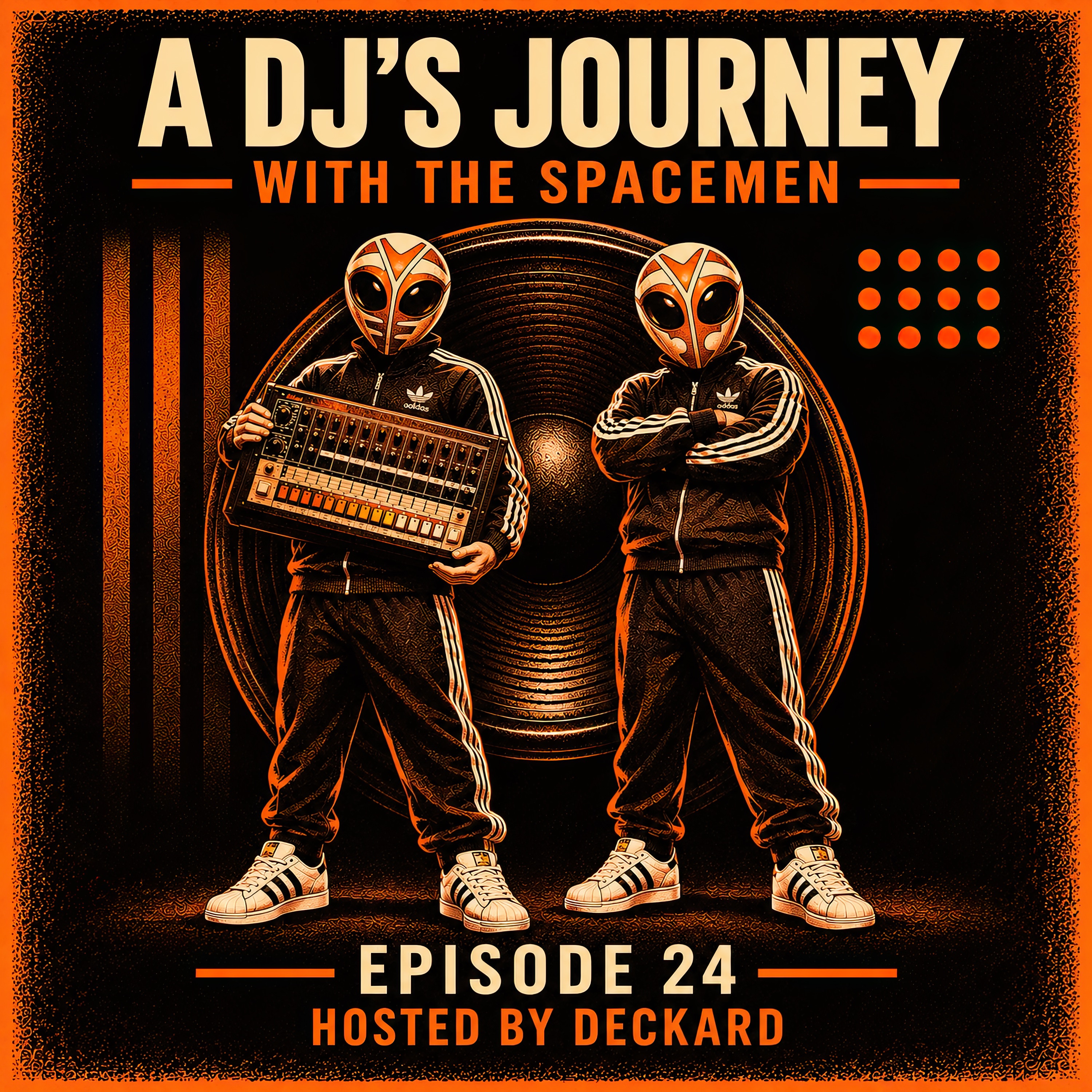
- 01How a library photo of American Gothic became a 30-year alien act — Danny picturing a spaceship above the farmers
- 02DJ Trip's South Florida roots as Beatmaster Wizz — Vicious Bass, Magic Mike's Royal Posse, 2 Live Crew
- 03Danny B's Miami bass and freestyle production credits — System II, Subliminal, and a long list of ghost-written records
- 04Pumping compressed air into sealed alien masks: “we had no idea that wasn't good for you”
- 05Getting tracks onto MTV — and how a 30-year duo splits the work and “takes turns wearing the same hats”
- 06Surviving Napster and the post-9/11 collapse of the record business
- 07A single dad putting out his daughter's first record — on his own label
DJ Trip (Keith Rosenberg) came up in the early Miami bass days as Beatmaster Wizz — Vicious Bass, Magic Mike's Royal Posse, 2 Live Crew territory — before Trip Theory and The Spacemen. Half of a duo that has performed as aliens for three decades.
Danny B (Dana Brown, also Subliminal / Lil Danny B) spent years writing and producing Miami bass and freestyle — System II and a long list of records credited under other names — before forming The Spacemen. The one who looked at American Gothic and saw a spaceship.
Subscribe to The Crate Letter at adjsjourney.beehiiv.com.
Keith MacKenzie appears in Episode 5 — the Florida breaks scene from the Orlando/Tampa side, the same DJ Icey / Magic Mike pantheon The Spacemen came up in. Two views of the same Florida bass map.
The Freestylers (Episode 14) and Krafty Kuts (Episode 11) carry the breakbeat thread from the UK side — different geography, same love of the break.
Short-form highlights from The Spacemen's episode. Watch the full conversation on YouTube or Spotify.
Introduction
A Two-State Remote Duo
welcome to a DJ's journey. I'm your host, Deckard. I am joined today by the Spacemen. So happy to have you guys on. I'm just curious, you know, you guys are not even in the in the same state. So where do you how do you find yourself working together at this point in your in your careers?
I mean to be quite honest, what y y you' you're looking at it. We we video conference and we send files back and forth. And yeah, I mean it's with technology now it makes it a lot easier, for sure.
I mean it's certain
And yeah, good.
I was gonna say it's certainly different from when we used to spend times in the studio together hours after hours after hours.
Well my guess.
but sending files back and forth is still getting the job done.
Yeah, we could work together at the same time or we could do it when we can do it individual individually.
From a South Florida Kid to Beatmaster Wizz
So before before you got into Spaceman, how did a South Florida kid become Beatmaster whiz?
Ha ha.
Well, honestly, it all started with breakdancing. I was a break dancer and I I got I moved it. I moved to a different town and started making friends because of my breakdancing. And then I got really good at it. So because of that, everybody else who was better than me at that time moved on to being becoming DJs. So I was like, All right, I could do that too. So I started becoming a DJ. and then those DJs eventually became rappers, started rapping in my face and then I was like, All right, I'm gonna start rapping too. So that's where like my music career started. So I started entering like contests everywhere, dance contests, rap contests and all that. And that's what really kicked off my music career and basically go ahead.
How what what years like how old were you and what what what year, what era was that?
Ooh, man. I was probably well, when I first started breakdancing, I was about fifteen, fourteen, fifteen. And if you're gonna ask for the year, I'd rather not say, no, just kidding. I I I don't think about that. But that was when breakdancing just, you know, really started to come in fruition everywhere, you know. So I I saw it first in New York. I was at a teen teenage nightclub for the first time. and that's where I saw it and fell in love with it. And that's really just what kicked off my whole love of music and just moving on to where we are now.
And Danny, how'd you get your your inroads in?
boy, music has been in my life since day one. I remember my par I mean, I'm a Gen X guy, and my parents grew up you know, growing up in the seventies. My parents would go out to Studio 54 and my dad would come home with real to reel tapes from the DJ booth and play them and I was just fascinated. I just I I couldn't understand the energy, the vibe. And I I just always loved music. And then growing up You know, again, you know, me and Keith are the same age, the breakdancing and the music. And then then I heard Planet Rock. Planet Rock, play at your own risk. John Roby and Arnha Baker, I have to say, they are the ones who definitely wanted me to definitely wanted me to do what make me do what I do. I just can't explain it. I mean, you can probably hear it in our styles. I mean, it's just the same vibe. I mean, I just it's part of me. It's part of my soul. Me and Keith were just talking about how you know, how you know, out of these thirty years we've been together, just the ups and the downs, the the peaks and the valleys of you know where we were as a band at the time. And Yeah, basically that.
First Records, First Turntables
D what was do you remember what your first record was, each of you? The first record you ever bought?
First record I ever bought was Planet Rock.
Was Planet Rec.
Yes. And then I w went excuse I'm sorry. And then I went to
No, no.
service merchandise and I purchased two belt drive turntables and then to Radio Shack to get that mixer. I don't even remember the model number. But yeah, we went there. And that
I know what it looked like. I had that same reading check mixture.
was the start of my yes. So when I finally got a hold of some twelve hundreds, I was like, my God, I'm amazing because I mean you're trying to ride these beats on belt drive. I don't know if you're a D if you DJ like that, but terrible.
Keith, you remember your first record? And your and and your
Yeah.
first turn tables for that matter, or your first gear you bought?
Yeah, well, definitely one of my first records actually was very similar to Danny. I actually was somebody gave me the whole album, the whole Tommy Boy album. It was I think it was
Greatest beats.
yeah, I think that's what it was, right? And it had and it had the remix on it and everything. Yeah, that was like one of my first. And
Yeah, bro, all that stuff. Pack jam, all those all the mine.
I had a belt drive turn table. I'll never forget I asked my grandmother, I was I was young, I asked my grandmother to buy me a DJ mixer. She couldn't s understand for the life of her what I would do with that. and
Yeah.
and then and then I start also started like dubbing tapes from cassette tape to cassette tape on on dual cassette tape players and making mixes that way. Well along with the the turntable. Yep. Yeah. Yeah. Yep. That's that's how we started
Tape edits. Yeah, tape editing, bro. I used to do that. Yep. Yep. I used to bro, amazing.
for sure.
The Lat the Latin rascals. They used ninety two WKTU in New York growing up. Those guys were the king of editing. And that's I don't know if I don't know what inspired you to do the tape edits, Keith, but those guys I mean I didn't have the money to buy a real to real, a razor blade or a block to edit, but that's how we did it back then for our mixtapes.
That's yeah.
So
Funny man. W We go back.
so so you went
We go back.
so when you're talking about like, you know, and you and Keith, you're talking about like friends rapping and kind of getting into that, like what was that? Like, you know, was that also, you know, was that house parties that this is going on? Is this also like then then starting to like, you know, bleed into clubs or what, you know, how how did you how did it go from say breakdancing at home or with friends to to like club scenes?
Well, I was as a teenager, I was I learned how to drive and we were going to the teen clubs and they were having contests, you know, like talent contests, and eventually I got up the nerve to get up there and did and I started winning and I did the same thing at school. I was winning a lot of contests at school.
And this sounds a lot like eight mile.
Yeah. It's it's the real deal. This is how it all went down, you know. I mean
That's and right there. Look at that Seminam right there.
But I you know, I was I used to enter dance contests too. So it
Yeah.
wasn't just the rapping, it was the dancing and I just really enjoyed it and and got a lot of attention for it and you know, got noticed by a lot of people telling me,
Excuse
Wow, this is probably what you should be doing. So I just moved on into the music business over time. I mean that's really yeah.
Did you did you work did you work in the the record business in any way? Like or were you you know, or d or just like, you know, DJ performing, et cetera?
no, I didn't no yeah, I was just D I I was DJing I DJed at some clubs when I was younger. too young to be in those clubs, but I was DJing at the clubs. for sure. I I was able to get a lot of work actually DJing at the clubs when I was a young teen, actually. So it was definitely that helped kickstart it too, because you know, I already got the experience of playing in front of crowds, though at that point it wasn't my own music. So It's totally different when you're playing somebody else's song than playing your own song, so
Danny B's Miami Bass Production Roots
Right. And Danny, you well ha the what what was your ends? I mean you you have a lot of production and and you know, credits to your name from back in your early days, yeah. What how what was your path?
My path. My path was I I got kicked out of my house in Brooklyn from my mom. I was I was a bad kid and my dad took me in and I moved to Florida. although I did get to experience the music that I did in New York, I never really got a chance to actually act on it professionally. Yeah, my dad supported my career. He bought me a keyboard, he bought me a guitar and In Brooklyn, I would just sit there and I would just learn how to play all of the lead lines of all the popular songs, teaching myself how to play. That was about, you that was, you know, I was about fourteen, fifteen when he did that. I got sent out to Florida when I was around eighteen. And I was still in high school and I had to go to summer school. And I went to summer school with a guy named Luis Diaz. And Lewis was just a kid who went to a high school who was going to summer school for some credits. And we started doing music together and you know, he's a drummer. I played keyboards and we messed around and started doing some freestyle stuff. And we wound up meeting this guy named Danny Canary. And we started recording in his studio and we started a record label together and it was called Tone Deaf Records. And this is all in like nineteen eighty six, nineteen eighty seven. And that's when I moved there. So this is like the first year or two that I'm living in Florida. And from there we just started putting out Miami bass and freestyle music from there. And that just started off as a small independent label and just that was just what got my traction going as far as the music business goes.
And Keith, on on your side, so so when you you said it you had changed when when you went from playing other people's music. So when did you really start, you know, creating music your on your own and starting to think that, you know, that that transition from DJing other people's to playing
Yeah.
your own?
Well, I I had a a friend that lived down the street and me and him used to joke around rapping a lot. So I eventually started a group called Vicious Beat, which over time became Vicious Bass, which was DJ Magic Mike's Royal Posse. if you pick up that album. So that that's where Vicious Bass came from. We started as Vicious Beat. Vicious Beat was me and DJ Lace at the time, and then eventually I met Madness and and brought him into the group. And then we we recorded two songs. One was called Speaking on V D and the other one was called All in the Mic. So Power 96, the main the biggest radio station down in Miami, they had a contest. Send in your best song, and then you'll you'll be in the battle of the bands for a record contract with Joey Boy Records. So yeah.
I remember that. A long time ago.
So out of ten thousand cassette tapes, by the way, because it was cassette tapes back then, we were one of the ten.
Ha ha.
So we went and we did a battle of the bands. We went against like four other groups, we won, then we went against the other the winner of the other weekend and we won the record board contract. And that's really where things really kicked off for the music career for us. But it it was all in the rap in the rap industry at that point, at that time.
What what was that I mean, what's that feeling like? I mean that's that's a ton of competition. Did you were you con were you confident in yourself? Like were you feeling like, you know, I'm I'm I'm good enough to beat the ten thousand other people?
You know, I had no I honestly we thought we were good, but I didn't know we were good enough to win that and win when when I got that phone call, I was blown away. But I mean that was the most one of the most exciting experiences back then, just to win off of a cassette tape and you know, like the the radio station loves our song and label wants to h you know, sign us. And back then Joey Boy Records was one of the top labels for Miami Bass music back then. So
Did so I'm curious, did you have was it did you have any like imposter syndrome or were you like, you know, hell yeah, let's go. I I got this or both.
How do you know this guy? He he this guy he he's a star.
No, I was like, hell yeah, let's go. Hell yeah, let's go. Yep. I, you know, the ra the one the the one the difference between what we do now and what and when I was doing rap music, it's just different because you're you're you're up front, you're on the microphone, you know, they're hearing your voice too. And it's not not that I'm not I don't want to say it's just music, but you know, it's different when you're like the lead, let's say person of of the band at at that time, you know, so everybody when they're repeating your words on s you know, when you're on stage, just I can't even express how what a feeling that is.
Yeah. So
Left your mark.
and and and again correct correct me along the way here since there's I you guys have a lot of a lot of different productions and names to you, but so at what point did Trip Theory come up b before Spaceman, right?
Yes, before a space fan.
Okay. And then so what was and what was that so y you said it was more, you know, you were doing more rap and then so where did you kinda get into more of the, you know, the bass or or Florida breaks or break that down for me.
I was doing I was doing some cover songs, all bass versions of old like freestyle electro, 80s electro music for InterSound Records out of Georgia. And I wasn't really thinking about, you know, tr trip theory or anything like that at that time. But then I ran into Danny. At some point. We we've known each other for a long time, just like, but not never really worked on anything together. But he Yeah.
Music business acquaintances. Shows together, stuff like that.
So he had already started a group called System Two and he had some music that I really liked. And I was like, Man, this is what I want to do for the next few albums on my label. So I sent them his music to the label and say, This is what I want to do. And I had to convince them to allow me to go from bass music to to break beats. So and that's that's what really kicked it off. And at that point, I had to ask Danny to be part of Trip There it.
And Danny, what w what's your what's your memory of of those times and and leading up to you guys joining forces?
Well, yeah, like he said, you know, I was doing system two stuff and and we were doing really I mean, we were playing a lot of shows and we were we would we were starting to pick up when Keith approached me to s to do this trip theory thing. He explained to me he had this album deal with Inner Sound and that, you know, he he he's gonna fulfill this contract and want to know if I wanted to be a part of it. And I would I would love to have been a part of it. I mean, this is our paths crossing because we've known each other. For so long, and you know, we've just never had a chance to collaborate our talent. And yet, again, since I was so busy with system two, I had to pass up on the offer. Again, here we are, and we just crossing paths and not doing it again. And then after that, I'm a little blurry about after that. So, Wizzy, you pick it from
so after that, I started the project. I was recording in in a studio in in South Beach and the person that was running the studio had a couple of songs that I kind of liked and I was like, you know, I I only had like three months to do every every C D, which is hard, you know, especially by yourself to do all that all that music. So He had two tracks that I kind of dug and I was like, you know what? I'll tell you what. If if I could put those on there, I'll I'll I'll pay you a certain amount per album. So this way I could be in the studio as long as I need to and get everything done right. And and I recorded with with somebody else as trip theory at that time. And then we wound up it wound up becoming a hit. It started charting. We got a lot of mentions in magazines. All of sudden we were doing shows from Louis Louisiana to Puerto Rico. And we were just like it was just snowballing. It was crazy how it took off. So I wanted to continue on with that. And eventually we wound up making another. We went from Trip on XB in the first CD, then we went to Something for Your Mind. Then eventually, you know, I got back to really we ran into some some stuff to where I was just like, I really want. Danny back in you know in the picture. So we s we s we just started hanging out in the studio and then I was working on a song called The bass men are coming. And I if you want to fill in the blanks from there, Danny. Just
So
to be clear, it was a it was a bass song that I was doing for Trip Theory. And we and then go ahead, take it from there.
So while Keith was doing the, you know, was doing his trip there thing. I started blowing up with the system two stuff. And at the time, Miami Freestyle legend Tolga, Tolga Kitash, you know I talked him into putting out a system two album. So me and my partner at the time, Caesar, we were working on a system two album and we s you know, we're playing at all these raves and and we're doing at that time there weren't many live shows. And system two was but we didn't DJ, we just it was completely live. All of our instruments were live, everything was midied together, it was, you know, it didn't sound phenomenal, obviously, because you know I went to a Mackey mixer. But we're doing that and we're approached by Bo Crane of Pandisk Records to do a Miami-based Christmas album.
You you were I was doing a lot of stuff for Bo Crane. I was doing my my rap stuff for for Panasc that time. And then the person in charge of that album was pretty much Neil Case. he was the the engineer and stuff like that. So
A beat dominator.
We were close. We did a big big hit song together. One, two, three, four, five, six bass. So, anyways, I was doing two songs on the album. Wounds up Danny was doing probably two songs on the album or maybe more than that. I don't remember.
Yeah, I c yeah, yeah, I did like three something like that. whatever.
But we wound up doing it in the same studio all the way in in downtown Miami, right? That's where it was, downtown Miami.
Yes, this is pre-trip theory. You yeah, 'cause you skipped ahead so far. Yeah. Ski yeah, I tell you.
Yes, yes. I that's what I'm saying, I went so far ahead. Well, you asked about trip maybe so I can't yeah.
It's all we'll do it. We're gonna we're gonna
Yeah.
that's okay. We're we can do time hopping. It's all right.
So he worked on he worked on two songs, I worked on two songs and the album the C D was actually a pretty big hit and it still sells every single year. It comes out at the same time every year. So
And we watch our royalties dissipate.
Yeah.
That's a whole nother story. I put that in the timeline.
But was that was just another part of the timeline where, you know, we were at the same place at the same time in in the region. Yeah. Yeah.
We're constantly crossing paths but we're not doing anything about it. It's
So so this so this
so weird.
The Florida Bass Map: 2 Live Crew, Orlando, Tampa
so and I'm interested about this too. So I had Keith McKenzie on episode five and he was talking about coming up through Orlando, Tampa, and like, you know, DJ IC's zone records and subsonic out of Clearwater.
Mm.
so could you tell me a little bit maybe about you know the and and as you know, and back at that for me my inroads was was two live crew. You know, so like my my understanding of like what kind of Miami bass music was and that that was it wouldn't go it didn't extend too much further than that, quite honestly. Florida, for whatever reason, Florida was just it was, you know, a l it was just out of my realm a little bit. So what was that like? You know, were were those different scenes in Florida, were they that different? Were they kind of in communication with each other, so to speak, or or were they kind of separate scenes down there?
far as what do you mean, as far as the genre of
Well, yeah, I mean, yeah, both the both the genre and you know, and and just you know, geography wise, I'm not I'm not sure like, you know, i Orlando, Tampa versus Miami or you know, w was it all very similar or was it kind of different genres and scenes?
Actually, no, you know, it was more separated, I would say. And I would have to say technology wise, why. You know,
Mm-hmm.
the connect the communication wasn't what it is nowadays, where you can communicate on the other side of the world like we're doing right now. You know what I'm saying? You didn't have that really back then. So scenes were different. You know, people found out about events and stuff via flyers, because if there was a big party in Florida, you could bet. that people in Orlando were down there flying vehicles. And that's how it was pretty much everyone found out about it. It was, you know, word of mouth, I guess you could say. Yeah.
Keith, you you would you agree? Similar?
Yeah, yeah. I I would say Miami base was very regional in the in the beginning, you know, and like northerners, like people from New York and all, they didn't even know what that was in the in the beginning. Two Live Crew kinda opened the doors for all of us with that. But that was when they had all that controversy, you know, with ban in the USA and all that stuff. Which I was at
Yeah, the the proud share of us. Yeah, yeah.
that w which is actually the the club where they got arrested at.
We were both there.
yeah, yeah.
We were both there, spinners.
When they got arrested?
Spinners. In Hollywood, right by the train tracks.
No, we've just been to that club several times. I've done
Yeah, cloud, okay.
I've done rap shows shows there, you know, before all that went down. So
Yes. Yep.
Yeah.
but as far as a connection, I mean, I gotta tell you, I mean, you know, I I took my my Miami based style and then just added it, you know, to Tript Drian Spaceman. So when you when you hear that booty based feel and all that's coming from, you know, my my history of Miami. Yeah.
I couldn't have said it better. I couldn't have said it better. I the same thing. I I I'm just following my roots and just modernizing it. You know, as technology grows I like to take advantage of it and you know and evolve. I mean, isn't that what music is about? Evolution?
Forming the Partnership
So okay, so then so then jumping back to what you guys were saying, you guys are kind of crossing paths all over the place. When
Yeah.
when and what did it take for you guys to really you know, and and I know that there's a another member a trip theory as well, but you know, so w when did spacemen come together and what what's the story of you guys kind of really becoming a duo?
So now pick up
I mean
from there, Wizzy. N now pick up from the studio baseman are coming.
Yeah, that that so then that bass men are coming song kind of like sparked we we decided to turn that into a song for not so much for a trip theory, but we came up with the idea of changing it to the spacemen are coming.
So from that part, I had a partner at the time. His name is Steve
There. Yeah. Good.
Koch. Rest in peace. He's he's not with us anymore. And Steve was a big rave promoter at the time. His mu his production name was Intervision Productions. Okay. Through a lot of early rave events all over the place in South Florida. And we partnered up. to start a record label together in a Vision Music. Okay? And we needed to put a band together. So I was like, okay. Now at the time, you know, I'm friendly with the owner of the studio that Keith is partners with. So I go down there, I got a brand new keyboard. We go down to the studio and we're playing along. I'm I'm you know, I'm playing along to some beat that that Keith's got going on called Bassemen Are Coming. And I'm just sitting there riffing out on the keyboards, jamming, and we started recording it and it sounded really good. And and we're like all of us are like together, like, this sounds like the sp the spacemen are coming. And blah blah blah. And we kinda lifted at that, you know, we're at whatever. So another
Yeah. Yeah.
day, Steve and I go to the library because we're looking up. We want to start a band and we wanna start a theme band. It needs to be a theme. Something that people are gonna remember long after the music. So we're looking through books and look magazines, just anything to to get the to get the flow going. All in the back of my mind, subliminally, no pun intended. All in the back of my mind. That the spacemen are coming. You know what I mean? It was just there in the back of my head. I was kind of fresh. so we're in the library, me and Steve. Thank you for that. So me and Steve are we looking through stuff and I see this cool picture. And it's I don't know if it's a Norman Rockwell picture. I don't know. It's a picture of an older couple, an older you know, grandparently, pitchfork and wife just standing in front of their house on their farm. And I just envision a spaceship above them. I don't know, men in black, I don't know. And I'm thinking to myself, holy shit, the spacemen are coming. And this, Steve, our theme is the aliens. And I'll get back to you on a name. I went back with these guys and told them what was going on. And we said, let's fuck, let's do it. Let's do it. The spacemen are coming. So we finished up that track. I went to Steve. He loved the idea. Well, me we're working on music. He's working on the whole concept video stuff. Costumes, masks, everything we need. Steve was the financier for the whole project at the time. So Now we finish the Spacemen Are Coming and we come up with this brilliant idea to ride Trip Dairy's coattails, okay? Putting the Spacemen Are Coming as a subliminal message on their album. So people didn't get it at first, obviously. And then we started doing recording how many singles did we we did abduction and arrival, do you remember?
Mm-hmm. Yep. That's where we started. For sure.
And we started doing shows and people started catching on the spacemen are coming, because at the time, Trip Theory obviously was starting to blow up first. You know, Spacemen was just riding the coattails. And the introduction, people's like, okay, they get it now, they get it now. Because it was a popular song that Spacemen Are Coming. People just didn't get it at first.
“The Spacemen Are Coming”: The Alien Concept
So you went where did you know, so I love the idea that that you're that you're you're kind of tipping it off, about you know, the spacemen are coming. So did you was was there we was that plan already in place then that that no. Okay, so it was just the idea.
It's just everything, it's just the universe combined. It just happens.
And and how and how on earth did you decide to actually like start performing on stage with like Alien Mash on?
Well, that's where Steve comes in. We decided we're doing an alien theme band. He's like, okay. And he just ran with it. He got costume designers to design his costumes. He got people to design his masks, which we've gone through several different versions. We've almost died during several shows with an air compressor blowing
Okay.
compressed air into our masks. We had no idea that wasn't good for you.
Yeah. I remember that.
The stories, The stories. Jeez.
Can you can you give me give me a okay, so so and I'm curious about this too, because as a DJ, I I never really wanted to be in a band. I've always loved music. And one of the things that I've always been really grateful for, though, was I just need to really just show up with my music and headphones, and I'm pretty much good to go. So b both of you going down this path of wanting to perform the music live, so I'm just curious, you're adding on degrees of difficulty, but but also the possibility for for doing something unique. I would love to hear just some stories about that too. there's shows where you almost almost died or something, right? So so give me give me
Almost Dying in the Costumes
HMM
like give me a peak story that said, you know, my god, we're really on to something, and then then maybe the opposite of where's a story where you just said, my God, should we keep doing this?
Keith, stop right there, Keith. You're gonna tell this story. And it's all about, I don't even remember the guy's name, the Seattle trip with cousin Sean and Steve, don't you remember?
When I was messing with the guy in the airport, you mean?
Yes, tell him that story. That's a great story, bro.
Well we're just characters and the the the the best thing about the two of us, costume or no costume, we could joke together and just
We bounce off each other, we're like smothers brothers.
So we were going to Seattle.
You know who they are.
I think we were in the Fort Lauderdale airport. And the guy behind the desk, his name was Jerry or something like that. Warren.
W-worrying.
Warren. And I was going, I was going, Warren. And then he was just looking
Yeah.
like, where is that coming from? And he's go ahead, what what did I miss?
Alright, so just to catch you up on why he talks like that, he doesn't have any mental issues. He Excuse me. Hold on. So we're on, usually when we're boarding a plane, you know, he likes to throw his voice and mess with people. He'll start meowing. Go ahead, show him, him an example with you. Like, he his voice very well. It sounds like it's coming
man, I can't. Wow.
from somewhere else. Anyway, when he does that, I would have my backpack and I'd start, I'd be like, shh, shh, shh, you're gonna get me in trouble. You're gonna get me in trouble thinking it's like an animal in the bag. So I'd start
Yeah.
beating it against the wall and... People would be like, my God, they're gonna hurt the animal. Anyways, to pick up the story from, he messes with people a lot.
And and then he he would throw he would throw the bag on the floor and then we'd start kicking it up the the aisle for
Little kids were horrified, I felt terrible.
man, we we we were definitely jokesters for sure. So so I I just did
We like that we always like to mess with people, you know?
let up on that guy in the airport. He we were driving him absolutely crazy. And I and I think that was probably the longest flight we ever had because I think there might have been a hurricane or something going on that held us.
Basically, there was no connect. They had to cancel one of our flights. So we had like three or four flights to get to Seattle. This must have been
Yeah.
a 12 hour trip. We get there to play. We didn't even get to go to the hotel. We just went right on.
Yeah. We went right on, went back to the hotel and then we didn't even get to rest and
With the...
then we had to go back to the ho to the airport again.
with the air compressors. That was one of the first air compressor shoes.
Yeah. Yeah.
I'll never forget it.
We had no clue that wasn't good for us, but we were breathing that sucker in. Well, we were you gotta those were the older masks,
So, so tell them something.
they were harder to breathing.
So continue about Warren and how we finally got our flights and then how. Basically, we got a ride from one of the guys with the little things that the carts and Steve was hanging on with the luggage cart.
And then fell and hit his hurt his leg, right? Should you know, I I haven't thought about this in such a long
Some lab stuff, don't you remember these better than me?
time. It's just a little bit coming back right now. It's so funny. We I don't I don't really remember much behind.
Yeah, these are like, it's starting to come back to me as we talk about it.
Start starting to come back. Well, so so
You know, you I'll be
and maybe and maybe tell this because I'm I'm curious. so I I've had this is the first first time I've interviewed two people at the same time, but I've had you know three other duos on, you know, Plump DJs, Fort Knox 5, and who's
How a 30-Year Duo Splits the Work
Nice.
the other one? I'm forgetting the other one at the moment, but and so I'm I'm curious about when so when you started working together, who Who drives what? Who is you know, how how did you determine, you know, was one person, you know, kind of more of the the builder, one's more of the navigator? Like how how how did you break down, you know, how you work together?
You mean our musical styles?
Yeah, you know, both both on how you put music together and and or, you know, like 'cause you have this live component, so you know, I'm just curious about
Right.
how how it all came together and how you how you break up the work between each other.
Well, all, mean, Keith and ourselves, I mean, we're both separate artists on our own. So I'll put together some tracks, he'll put together some tracks and we'll present it and we work on it. You know, we all add our flavor to it at the time when we in the studio together back then.
I mean, there were a lot of times where like I would start a beat, Danny would come over and then just like lay like 20 lines over it and then I'd pick and choose what I think works together and then you know we put a song together. We did a lot of work, you know,
Yeah, exactly.
like that. Sometimes he'll send me some keyboard, he'll
BAM!
start with some keyboard lines and then I'll work on a beat around it. It just it just worked both ways and it always complimented each other.
Yeah, we just fed off each other very well. You know, not only character wise, but workflow wise as well, you know.
So so so both I guess both of you can you can both take take turns wearing the same hats, more or less?
we can almost finish each other's sentences. And I don't even like the guy.
I I've noticed. I've I Obviously. So little so little affection between you guys. It it shows.
Yeah, that's my boy.
so and I don't know
Kidding? 30 years together, that's crazy.
Getting Tracks on MTV
if I'm jumping around too much, but so if I'm not mistaken, you guys got a couple couple tracks like featured and on MTV and or MTV shows.
yeah, yeah, yeah, tell me about the other one. The white man can't crunk. That project was easy.
Well, we have so we started a project, a crunk project, years ago. I'm trying to I can't tell you exactly maybe 2006, somewhere around there. And it was called White Men Can't Crunk. So I I found a rapper to rap on it. We we did the music, and that song wound up on the first episode, series one, episode one of Robin Big on MTV. And then after that it took off and was on like probably like six, seven other shows after and still to this day it's still being played on on all those shows. On site, USA Network site
You're a lot of you are... You're psych... Girlfriends?
G G's to Jan's girlfriends from CW. gosh, there's so many
Yeah, that one did really well.
shows that it I don't I don't even remember all of them, but there's a bunch of them that that it's on.
You know what though, it definitely opened up an avenue for us to license our music to do a lot of shows. There's a lot of stuff that we've gotten that's been background music on a lot of TV shows that nobody even knows that we're doing, you know, that it's just licensing and publishing that we get from that.
Right.
I mean I c I could tell you just Yeah, go ahead.
no, no, go ahead, go ahead.
I said I could tell you just a
Shetmono.
quick story. What the Jet Moto, yeah. Well, what happened was when I was inner
Jet Moto, resistance is futile,
sound as Trip Theory, we I was watching TV and I heard a commercial on on MTV and I heard eight days a tweak from Trip Theory song in it. So I told the record label and they called them and did they denied that they used it. So but they the guy said it's okay, but just send me their send me all their stuff, right? They wound up putting every single song on both CDs on Real World Road Rules, Real World Road Rules Challenge, like all of those shows, like it was every single song was used on all of those shows. So that was like the that's
It's awesome, yep.
where that all started then. Then I met somebody
Yeah.
that that works in licensing and all that. And that's how we got white man Ken Crunk out out of there. And and they have all our other stuff. It's all being played like on a lot of shows right now to this day.
Dude, how about, shake that thing on King of Queens?
Yep. from my old rap music my old rap group, King of Queens. There was a episode where they were visiting Florida on spring break and then outside on the patio they were playing my
It's hilarious.
group song Shake That Thing and they were yelling at and then they
Who's?
started act to lower the music and then they started actually rapping along with the song during the show. So that was really cool.
I mean, they must have played the song for five or six minutes in different sections. I mean, I'm sure that royalty check was beautiful.
Yeah. Yeah. But another
Yeah.
another cool thing which I I was talking about recently, I have a song, a two BMF, my old rap stuff song on
you
what's that guy's what's the guy I just sent you? The guy who plays Borat.
Sasha, Sasha.
You know Huh.
Sasha Bam Sasha
But but he but he had a HBO special. what what's it called?
Olly G.
Ali G, yeah.
L G.
So so he plays my song Dance Like a Freak and he comes out dancing and rapping to my song at the beginning of his show in one of the episodes. So Yeah, we have a lot of stuff out there. It's like all over the place. So
Yeah, it's pretty cool, man. So don't even know half of this stuff. I mean, we ain't keep them in doing this since we're teenagers, you know, we got so much uncredited shit out there. It's insane.
Napster, 9/11 & the Industry Collapse
So and I'm curious too then. So it seems like from around say two thousand, maybe even up to like, I don't know, two thousand five, six, somewhere somewhere in there. it and this has been, you know, a lot of the other artist DJ producers I've talked to, a lot of them ran into that, you know, kind of the Napster cliff. where it went from, you know, you're selling records and you know, you could have a a huge success off of, you know, whatever, you know, you sell ten thousand records or something. I mean you're you're doing great.
Yeah?
what was that? What was you know, so so you had all, you know, it sounds like you're having a lot of success getting music out there creatively. Did you run into a similar issue around that time, you know, with your own music?
Personally, I did for sure. We were selling vinyl, like you said, five, 10,000, 15,000 units of product. And now people are just getting it for free. It fell off. And that was besides shows. mean, that's our bread and butter. And
Yeah.
people are stealing, not only are they taking our music for free, but I it's terrible. So we have to figure out and adapt to the new way. Obviously, it's never gonna be the same again, but show-wise is where the business is taking us, at least us, that allows us to keep doing what we're doing. So yes, the answer to the next question is absolutely it has affected us.
Yeah. And
Well, part of part of part of why why it affected us too is because the promoters, a lot of those promoters were
Hmm.
DJs themselves. And those are the promoters that bought the vinyl, those are the promoters that played it and saw how the crowd reacted and booked us for that reason.
Yeah.
So then when they stopped selling and they s closed down the record stores, it definitely made an impact, one hundred percent.
So how how did how did you survive through through that? Did you have to well yeah, go ahead, I'll just let you answer.
No, I mean I mean we just we survived because we we we built a good name already at that point. You know, like we were we're we're we're at a pretty pretty high level already, you know, thank God, because if we were just starting out, we probably never would would have made it. But thank God we already built a name for ourselves between both groups. Yeah. I mean it it put a dent in
Kinda like coming over the crest of a wave, you know? We just kinda made it.
it. It put a dent in it, you brought us back a little bit, but it didn't it didn't stop us. If if that
Yeah.
makes sense.
Did you
Yeah.
did you were you were you a were you having to adapt or you know, or just lean into, you know, doing more live shows or
I had to adapt. personally am a studio musician. would play guitar, keyboards, whatever I could on other artists' stuff, uncredited of course, the session work. So I had to pick up a lot more of that to supplement. did. You do what you gotta do. Life happens, peaks,
Did you and then did you are you finding then that that is you know, at what point I guess did did it feel like or or has it, you know, come back any you know, cause it come back to where it was or like how how are you feeling about, you know, where the industry is now or how are your own your own performances when you're out there now?
That's a good question. Keith, why don't you take that one?
Yeah, I mean I mean I could say it's it's definitely not the same as what it used to be. every every I'm no guy. I I mean back then.
I want to... yeah. I was gonna say post 9-11. Post 9-11 everything changed. I mean post 9-11 destroyed the whole thing. I mean the industry was just shit.
Pri prior to that, we were I mean, we were in a different state every weekend, sometimes two states, you know, and we were just constantly traveling. And and and there was no
We have, yeah, we will fly, yes, every weekend.
such thing as a three hundred people show. They were just all fifteen hundred and above or or fifty thousand, you know.
every weekend. I mean, we're traveling all over the United States, you know, it's just, it was insane.
We didn't really do small club things or anything like that. Like when we first started, even even the first Trip Theory show that we played, even even though Danny wasn't part of Trip Theory at that moment, he played with us too. And it was even that show was fifteen hundred people. You know, like it's just different. The crowd is not like it was before unless it's a festival.
a little side note, a little side note. I played purposely because we were introducing the Spacemen, but still it was more of a subliminal message. You know what mean? So it's kind of like a whole thing.
But it's definitely changed. It's definitely it's definitely not
Yeah.
the same as it was for sure. you know, the shows aren't the the amount of people coming to the shows aren't the same. I they're coming, don't get me wrong. They're just not the big stadiums all the time like they were every single weekend for us back then. So
Yeah, the numbers aren't there anymore. know, back then, you know, the EDM rave scene was, you know, let's not fool anyone. It was a drug induced music scene.
Mm-hmm.
And today, I wouldn't say, you know, the festivals, I'm sure are still the same vibes, but a lot of our older fans, they're there for the music. They're not doing anything but maybe having a drink or two. You know, they're not doing what they were doing back in the day. So I think that's another reason why the crowds for that particular scene have diminished personally.
Yeah, I agree.
And Wh so is and as far as you you guys are currently on doing a twenty fifth anniversary tour, are you not?
Yes.
Her First Record: A Full-Circle Moment
So tell me tell me about that. What's what's that like coming around I you know I I would think you're both you're both incredibly proud of it. What's that like going twenty five
Man.
years on that work?
Well, shit, was that 25 year anniversary was the anniversary of the album, but it was more of a anniversary. was more of a 30th anniversary of the formation and the journey that we've taken. For the both of us over the course of
Get here. Yeah. Mm-hmm.
30 years, I mean, from doing shows every weekend to having families and having to provide for those families taking away from. or musical time per se. You know, we still did shows, not so much, but always in the background. Keith and I have always worked on music together, even though we never really shared it to our fans because we were just more in that state of mind at that time of our lives. You know, we both had kids, were babies and they all, they both grew up together and God bless. In fact, Keith's baby is getting married next month. bless. God bless, man. You know what mean? I watched her grow up. She's my baby. So, you know, we started, basically the whole album is our 30 year journey together. There's unreleased stuff on there that people have never heard. There's stuff that people might have heard at shows but could never get a hold of. It's the vault. It is the vault. We put it all in there. And by the way, shame was plugged. www.spacemenlive.com. can get that right now. I'm
Ha ha.
going
So no problem.
to send you a free copy, my friend. would not,
thank you. Thank you.
I want you to understand what we're talking about. You'll get the vibe if you hear the progression of the tracks and how we put it together. It's a story. You know, we tell stories.
I I was watching I saw I saw a YouTube clip from from I think it was from from Ultra from like nineteen years ago and you know, full on, packed house, got the alien costumes out, everything. So there's obviously a a lot of affection and joking between you two. I love the airplane story, the airport story. w was there was there a story that that you guys like a time when when you guys thought like you know that would break you or or break up the duo?
Never.
No?
Me
Mm, no.
and him, with the other guys, we all had our group, but me and Keith always had our bond. We were just talking about this before we went on this interview, how we always felt like we were the grownups. We stopped the bickering. We kind of stopped the arguing. Me Keith never had any bickering or arguing, you know? Between each other, I should say. With the other two, there could be children at some times.
No, no. Yeah. Yeah, for sure. For sure.
So, yeah. You know?
And like and like I said, we we between the two of us we were always the ones that could rely on each other, you know, and we and the problem that why we're not
Our children grew up together.
with Yeah, and why we don't work with those the people in the passive because they weren't reliable and that's what got us here to just the two of us.
You know, I mean, what do they call that? mean, you know, they got superstar syndrome. I guess you can call it, right?
certainly, yeah.
Yeah, their heads were a little big. and Keith went through that shit when we were like 18. They were going through it in their like late 20s. You know, DJs go through that shit. They think they're the shit, you know, whatever. Then, you know what?
Is there is there and from a you know and and and being in the industry with families can't can't be easy. is there is there anything that you know that that going on this journey cost you personally?
I know Keith got some stories of, I mean, Keith, let me tell you something. This man right here, he would be in the studio recording with his little daughter, you know, and taking care of her, he was a single dad, and God bless him, you know, she turned out to be a great woman, cause I am. shout out to that guy.
Yeah. So I took my my daughter was thank you, Danny. My daughter, I brought her to signing contracts
Okay, of course bro.
for for record labels to wherever. She went everywhere with me. So I carried her in the in
Yeah.
the carrier and everything. And I was just mom and dad. So that was that was
Yeah.
very interesting. And at the same time, there was a point in time, thank God for my mother at the time, because I was working for e Entertainment
God bless.
and I was working on a show called Wild On and I was traveling to all the Caribbean Islands with them at the same time as we were doing all these shows. So if it wasn't for my mother, I that would have been even a tougher task. But the n the
Yeah.
best thing about it is that though I was gone for the weekend, I was home Monday through Friday every single day because I wasn't working a regular job at that time. So because of our music, right? So
Yeah, he did right. The mother was not the enzyme at all. yeah.
Yeah. So I got I got
So
the chance to be both and we're tight, so mm hmm.
and and a lot of a lot of kids, you know, tend to not think their parents are cool, but how how do your how do your how do your kids think about, you know, both of you being in in music for, you know, sounds like your entire life since they've they've been part of it, right?
Yeah.
yeah. Well, they're they're our biggest fans, right? You know, funny story.
Ha ha ha.
Yeah, they are our biggest fans.
When I had when I did my daughter's sixteenth birthday, I was like, man, I'm gonna embarrass her on breakdance in front of all her friends. So after I did that, guess what? All her friends loved me after that. They were like, Holy shit, your dad is like awesome. So but but that
Yeah, there was a...
yeah, no, go, your turn.
what year was the Bang Music Festival? So in 2006 there was a festival in Miami called the Bang Music Festival. Daft Punk was the headliners and we actually got to play on a stage next to their special set up. And it was amazing because Keith and I... You know, we had an RV, you know, at this time we're already an established app and we can get our green &Ms, know, just playing around. But
Yeah.
no, seriously though, it was an outside event and we needed a place to change into our costumes so that Primordiac got us an RV. So we were able to bring our families. We bought a grill, we grilled out, we were backstage the whole time. It was an amazing experience. And ever since then, my daughter's been in love with everything that I do musically. So at least that's my
Yeah.
personal experience. With that,
Yeah.
you know, it was pretty cool.
Your are are e either of you are your kids musically inclined or, you know, picking up on trying to create music on on their own or?
Yes.
Yeah. Yeah, my
Yeah.
my daughter, my daughter is an unbelievable saxophone player. so much that they call her, they she's now going down actually today she's down south and they they're having her play with the the school band again because they invited her back. she's that good.
That's amazing.
And but she's also a lyricist. She could rap.
Yes.
prob maybe better than me, I don't know, but but
Definitely better than you. You've lost your chops, bro.
But
Yeah.
but she she's writing lyrics right now and releasing one of her tracks like in a week. So I'll definitely give you a heads up on that one. I'll shoot you a link.
Yeah, man.
That is that is that is she released before or is this like a f a first time?
This is gonna be her first release. She always we were just so busy. I really wanted to be her mentor and be there for a hundred percent, but it was so hard to do it when we're on the road all the time. And it sucks that I never being in the business
Yeah.
was able to give her that attention. So I'm like, you know what? Keep writing your stuff. I'm gonna start putting
got bills to pay, have day jobs.
it out on my label, you know? So I can't wait. So yeah.
I mean that's gotta be you're hugely proud.
yeah. yeah. Totally. Totally.
And we're not joking, she's pretty talented. That girl is talented for sure.
and I I asked this question of of everybody usually in the beginning of it, but let me jump back again real quick. You b you both kind of talked about, you know, both you know, break dancing and rap music and stuff, but was was your household musical as well? Or did you just kind of, you know, gravitate towards what you gravitated like as a as a teen?
For me personally, going back to the Studio 54 story with my parents going in the 70s, my dad was a high-fi nut. He had these giant Serwin Vegas speakers with like 18 inch woofers in a small Brooklyn apartment in a living room. I mean, you turn this on, it was like a block party. He had a Nakamichi cassette deck that had like, and this is what we're talking about in the 70s, you touch it. And it was like heat sensed, was like touch sensitive. This must have been like a $2,000 tape deck, from what I understand. A reel to reel tape, I mean it was a whole thing. So that kind of got me into the whole vibe of. of music and the quality and the production because I fucking heard it so goddamn loud I'm deaf from it now.
What what kind of what kind of music was he listening to? Would you listen to with with Disco Okay. Studio Discord.
Disco! Disco! Casey and the Sunshine Band, the Bee Gees. mean, that knife fever was the shit at the time. 1977, I was 10 years old. I was starting to get it in life, you know what I'm saying? Growing up in New York, you you just see things. I was starting to pick it up. And musically, that's just what got me. You know, I don't get me wrong, too. I love classic rock, Led Zeppelin. Guitar was my first instrument I ever picked up. Smoke on the Water was the first song I ever learned how to play. I'm the guitar by D. Perfume. And I just liked all music. I never looked at music. I personally don't know how Keith looks at his music, but music to me, I never looked at it from a genre point of view. I looked at it from a production point of view. I always listened to the quality, the melodies, what worked with what for some reason that always clicked with me, you know? And there are countries, so I mean, I hate country music. Don't get me wrong, I hate it. But some of them are put together very well. The way it's put them, the harmonization, I look at it, I pick it up, I learn from it, I pick up these techniques. I've
Right.
always been that way. I don't think you know, I keep saying you know because it's a Brooklyn thing, but I know you don't know.
You know.
and
No?
hey Keith, on your side, what was what what what were you listening to bef before you you kind of really got into it?
I mean, I grew up with my mother was into disco like like big time. My mother
Disco, okay.
and her friends in Brooklyn.
See you time.
We were from Brooklyn too originally. So she had friends that were DJs and they were DJing at the clubs and that's all I ever heard, you know. And I was I was always my mother's dance partner, you know? Like like I held her one finger and she would spin around and you know, I didn't move at all at that time, but you know, I was her dance partner for that. And it was always to disco music. So kind of grew I that wasn't the only thing I listened to, but I That's what like what I fell in love with when when I was younger. And that's what I heard in the house all the time. Yep. It's pretty much the same. Yeah.
energy, the high energy, the syncopated deeds. mean, it's just like a tribal thing. It's just that humans can, I mean, you know, I even think you have to like music just to hear something like that. It's just, it's a mental alteration. It's not to explain. mean, music has just always been a thing. It's in my blood, you know?
“I Don't Even Like the Guy”: 30 Years In
Right. So all right, I can see you guys love each other a lot and you guys get along great, but I want to know from each of you what's the thing that drives you crazy about the other one.
this fucking guy and his snoring. God damn. Excuse
Yeah.
my language. But, know, holy shit. I started
I don't believe I shouldn't.
it. I videotaped it.
I I never really tell.
I have videotaped it and sent it to him and said, no, bro, you need to work on this. Stop working on music right now. You need to fucking work on this, bro. I need a remix of the snoring. Thank you.
Keith?
oof, man. I don't
Farting. I know what he's gonna say. He's gonna say farting.
Yeah.
That's exactly it. You don't want to be in the same room when that one comes out. You could always tell when Danny was there.
You see, I knew it. Hey, sometimes I get nervous. You know, you're doing a show, I get a little nervous sometimes. The cream norm, you know, what are you gonna do? I'm still a human being. I've done this a thousand times and I'm nervous before everyone. I don't know why.
So he has to relieve himself next to me.
Well, you just happen to be there. If it was somebody else, I'd feel bad for them. Especially the last show when we got dressed in a freezer.
Yes. Yes. It was so hot. Thank God for that freezer.
Right recently.
That's, yeah, in Orlando, it was so hot. They let us go in the freezer and my glasses, I couldn't even see shit. was like so foggy, was steamy. Deckard (1:00:09) I love it. All right. okay, so v we're we're we're kind of in the home stretch here, but I'd love to know, tell me like what what were your some of your favorite venues or clubs or cities to perform Danny B (1:00:20) you Deckard (1:00:20) in? Danny B (1:00:23) I mean, you know, to be quite honest, I'm from Brooklyn, but Miami is my home. Club 1235, the Cameo, Deco's, Backstreet's, Joseph's, Trio's, Casanova's and Hialeah. I mean, there were so many places to go hear all these amazing DJs playing all this amazing music. and white labels that nobody else heard from this club today. was just such a library of knowledge, just going to these clubs every weekend and just picking it up. I'm watching other people dance, but I'm learning, you know? DJ Trip (1:01:07) The edge, the edge as well. That was later on down the river. Yeah. Danny B (1:01:10) Well, yeah, that was in the 90s, more of the rave stuff. I'm going back to like my home. I'm going back to the 84, 85. DJ Trip (1:01:18) Yeah, for me it was Nepenthes and then and then what what was it? Backstreets and all that, which became the edge eventually, you know, down the road. But we went Danny B (1:01:28) Right. And that's where we got our. DJ Trip (1:01:31) going to backstreets weren't Danny B (1:01:32) You're good. DJ Trip (1:01:33) old enough to we we we always had to sneak into that place. So but it was one it was one club Danny B (1:01:36) Fake ID. Carmen, I knew the door guy. DJ Trip (1:01:39) to another. We were just into the music, you know? It does it didn't matter where we were, we just wanted to have a good time. What's what's Danny B (1:01:45) Yeah, we were all underage, Deckard (1:01:45) Nice. Danny B (1:01:46) but you know. DJ Trip (1:01:47) Was that actually the question that you were asking, or were you wondering as far as spaceman and your shows? Deckard (1:01:50) Well well kind of both. I've you're well I I like I like the answer you gave. I was actually asking more about like, you know, just from a a performer, you know, like where where where what where you played that you really enjoyed playing. But I I like but this is a great answer. So so you can answer both. So so you know, from like from a spaceman perspective, you know, are there you know, are there certain cities or venues that are, you know, like your your home or just, you know, like that are the stand out to you? Danny B (1:02:18) Yes! DJ Trip (1:02:20) You gonna say it? Danny B (1:02:20) Backstreets. Backstreets started when I first moved to Florida. There's this venue. It's on Broward Boulevard in downtown Fort Lauderdale. And the first venue that I knew it was called, it was called Backstreets. This venue evolved over the years. It was a constant musical venue that was just famous. And eventually it became the edge. Okay. And you know, I would run into Keith there sometimes. And that's what started. That was just the venue that was ground zero for South Florida for raves Saturday nights into Sunday mornings, like 12 noon. And that was my spot. I don't know about you, Keith, but that venue was, you know. DJ Trip (1:03:08) Yeah, yeah, for sure. I mean, but we had we had when we were on the road, there was certain places that they just always wanted to bring us back. Like certain we were in Jacksonville a lot, Atlanta a lot, like at the globe. We were just talking recently about the globe. We were there a lot. And I I guess Danny B (1:03:22) Yeah, yeah. Club H2O. DJ Trip (1:03:27) H2O, that was Jacksonville. We were there a lot, you know, like we were the the the cool thing about us is because like at at one point, look because I wasn't really working for anybody at that time. We were able to come up with new music for almost every single show. we were able to play in the same venue like weeks later because we had a new song to play anyways. It wasn't like they were gonna see the same thing. So we had the ability to do that and we were and we worked pretty fast. Back then we could pop out some songs like like pretty darn quick because we were working together side by side. But we were able to do like we did a lot of stuff locally, like a lot, a lot, a lot. But then at some point we were just out of town so much and it was They always brought us back to the same places in Jacksonville, same places in Tampa, same places Orlando, like constantly. So it's hard to say which one, Danny B (1:04:14) We just had a fan base. DJ Trip (1:04:16) but we just had so much fun to all of those, you know. Deckard (1:04:20) Nice. Danny B (1:04:21) You know, away from, mean, the way we are, how we are, I guess you would imagine, just being away from our families so much at the time. You know, we're kind of like our own family. We're sleeping in the same room. I'm farting, he's snoring, and we are family. So we Deckard (1:04:38) Mm. Danny B (1:04:39) just hit the show on the road where that's just like Humpty Parties in the Burger King bathroom. You know what I'm saying? Same thing. Deckard (1:04:48) all right. I I I I I love your I love this interplay between you guys. It's great. Danny B (1:04:53) Thank Deckard (1:04:54) so who who else would like of of current music, like what's what is inspiring or or what do you guys what do you guys listen to now? Is like do you find yourself like is there new artists you you really dig or you know, are you listening to older stuff? DJ Trip (1:05:14) Mm. Danny B (1:05:15) I like, you know... Lately, like the music that I've been working on personally, I'm kind of like not really listening to what's going on on the charts so much as I used to before. I'm making music more like more for me and what I like and what I feel like-minded, you know, fans or musicians alike would like, you know? And that's the vibe that I've just been doing. I've I've done a lot of cover songs recently. of old classics that I know this new generation has never heard but needs to. know, stuff that inspired me. I'm not special. I'm just a normal person who happens to like music and so does the next person that might benefit from something that I created from years ago, you know? You know what I mean? Deckard (1:06:05) Yeah. Keith? DJ Trip (1:06:08) I mean, I don't think well for one, I I I don't think I've actually changed over the years and and I think that mine and Danny's music, whether it's basement or triptery, whatever it is, is just always sound different from from everybody else. I really don't I really don't think we sound like like anybody else out there. So I just I Danny B (1:06:25) We have our own vibe. DJ Trip (1:06:27) yeah, and I just don't really I don't I listen, but I don't listen too often to other people's music, except for like ol old older stuff like Like all the remakes that that Danny's done, like all the older music, rock and old electro and stuff like that and freestyle music. I love freestyle music. Like that's one of my favorites. But I don't I don't really pay too much attention to what's out there right now. Listen, I I I have Sirius XM and I keep it on the eighties, you know, in Deckard (1:06:58) Yeah. DJ Trip (1:06:58) the nineties. Seriously, I don't even listen. Danny B (1:06:58) 70s 70s DJ Trip (1:07:01) You know, so I and I think that's what keeps us making music the way that we do, because we're not following anybody else's trend. Deckard (1:07:11) Right, right. I'm just gonna throw I I Danny B (1:07:12) That's I don't want it. Deckard (1:07:13) I'm gonna throw it out there so people on the podcast hear this 'cause I I've been a actual at just an addict for one album and over the past like six weeks and it's been the Czarface album, last Zarface album. It's all it's all like it's Inspector Deck. I forget the other two guys' names, but two kind of indie rappers and it's it's like based on a cartoon character, but it's all like this like nineties, like updated nineties New York hip hop sound. So shout out shout out Danny B (1:07:44) Okay. Deckard (1:07:44) to anyone, give give it a give it a listen. I I it's been it's been like on repeat, and I can't get it out of my head lately. And that that for me that's actually kind of rare 'cause like I I tend to listen to stuff that I've listened to, you know, from the beginning of when I listen to on Danny B (1:07:56) No, that's amazing. Deckard (1:07:57) up. So Danny B (1:07:58) You're obviously a music lover. Thank you for the tip. Deckard (1:08:00) Yeah, absolutely. so it's been great having you guys on. appreciate it so much. and thank you for the the Danny B (1:08:08) Thank you. Deckard (1:08:09) the the background on the the Florida and the bass music scene, the Florida breaks. so it's DJ Trip (1:08:15) Mm-hmm. Deckard (1:08:15) been a been a pleasure, guys. DJ Trip (1:08:17) Thanks for having us for sure. Danny B (1:08:18) Thank you so much for having us, greatly appreciate it.